


Mobility Scooter Stability, Anti-Tip and Braking Performance Testing: A B2B Buyer’s Guide
For importers, DME distributors and procurement managers at care-home groups, a mobility scooter’s paint finish and unit price matter far less than how it behaves at the edge of safe operation. A unit that passes a polite showroom demo can still tip on a 9-degree curb cut or fail to stop on a rain-wet ramp. This guide explains the engineering tests that separate a compliant, insurable product from a liability, and shows buyers how to demand verifiable data instead of marketing prose. We focus on stability and braking because these two systems produce the highest rate of field incidents and the most expensive recall events across the EU and North American markets.
Tip: Always request the full stability and braking test report before confirming a container order, not after the stock arrives at your warehouse.
Static Stability Testing: Incline Angles and Tipping Thresholds
Static stability measures whether a parked or slowly moving scooter resists overturning when tilted. The reference methods appear in ISO 7176-1, which defines wheelchair vocabulary and test methods, and the adaptation in EN 12184 for electrically powered scooters and wheelchairs. The core procedure places the unit on an adjustable platform at a defined angle, with the most unfavorable load, meaning maximum user mass plus any front basket and rear baggage, and observes the tilt angle at which a wheel lifts. For a three-wheel scooter, front-wheel lift on a forward slope typically occurs between 10 and 14 degrees; for four-wheel units, lateral lift on a side slope usually appears at 12 to 16 degrees. A tip-over threshold of 12 degrees is a realistic floor for a stable four-wheel design with a low seat and ballast at the base.
Buyers should require the test to be run in all four orientations: nose-up, nose-down, left-side and right-side. Many factories only test nose-up because that orientation is the easiest to pass and the most flattering to report. A scooter that holds 14 degrees nose-up but lifts at 8 degrees on a left side slope has a dangerous asymmetry, often caused by an offset battery tray or a single-sided rear suspension arm. Record the angle to the nearest 0.5 degree and the applied mass to the nearest kilogram. A competent report also notes whether the anti-tip wheels contacted the surface before main-wheel lift, because that contact is what physically prevents the fall.
The repeatability of static testing is easier to control than dynamic testing, but only if the test surface is level to within 0.5 degree and the ballast is fixed, not hand-held. We have seen reports where a 5 kg sandbag was placed on the seat rather than clamped, which shifts during tilt and corrupts the result by one to two degrees. Specify a rigid ballast rig in the purchase specification so two laboratories produce comparable numbers.
Dynamic Stability: Cornering Rollover and Lateral Load Transfer
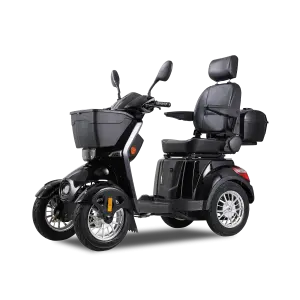
Static numbers describe a parked scooter. Dynamic stability describes one turning at speed, where inertia adds a lateral force that static tests cannot capture. The practical test drives the scooter in a constant-radius circle at increasing speed until either a wheel lifts or the rider reports loss of control. At a 2.5 m radius turn, a stable unit should hold 6 km/h without outer-wheel lift; many compact three-wheel models begin to lift the inner rear wheel at 5 to 6 km/h. The lateral acceleration limit is roughly the ratio of track width to center-of-gravity height, so widening the track or lowering the seat directly raises the safe cornering speed.
We recommend a two-phase protocol. Phase one runs on flat dry asphalt at 4, 6 and 8 km/h with a 100 kg and a 136 kg anthropometric dummy, logging speed at first wheel lift. Phase two adds a 6-degree cross-slope to simulate a sloped car park or a ramped shop entrance. A scooter that is safe at 8 km/h on flat ground may lift at 6 km/h on the cross-slope, because the slope reduces the available margin on the downhill side. Document the speed at first wheel lift for each condition, and reject any model whose dynamic limit falls below the electronic speed cap by more than 1 km/h, because that margin is what protects a real user who rounds a corner a little faster than advised.
An often-overlooked dynamic variable is steering rate. A sharp, fast turn input transfers more lateral load than a gentle one. Ask the laboratory to specify the steering input profile used, because a test with a slow hand input will overstate stability compared with a startled user’s reflex turn. Consistency of method matters more than the absolute number when you are comparing two candidate suppliers.
Anti-Tip Wheel Geometry: Wheelbase, Track Width and Center of Gravity
Anti-tip wheels are small casters mounted behind or ahead of the main wheels that touch the ground only when the frame rotates past a safe angle. Their effectiveness depends on geometry, not merely on presence. The rearward distance from the main drive wheel axle to the anti-tip contact point sets how far the frame can tilt before the caster loads; a 60 mm gap absorbs more tilt than a 30 mm gap, giving the rider more recovery time. The wheelbase of 920 mm paired with a track width near 640 mm is a common stable layout for mid-size scooters rated up to 136 kg.
Center of gravity height is the variable most factories under-test. Seat height, battery placement and a heavy front basket all raise the CoG. A practical design target keeps the center of gravity below 480 mm from the ground for a 136 kg user. Every 30 mm of CoG rise degrades the side-slope threshold by about 1 degree. When specifying, ask the factory for the CoG plot rather than a bare statement that anti-tip wheels are fitted. A fitted caster behind a high-CoG frame still permits a fall if the caster touches too late in the rotation.
Caster diameter also matters. A 50 mm caster rolls over small obstacles better than a 30 mm one, but a caster that is too large reduces ground clearance at the frame and can catch on thresholds. For indoor and pavement use, 50 to 75 mm is the workable band; for outdoor rough-terrain models, larger casters with suspension help but raise the CoG, so the geometry must be re-balanced rather than simply scaled up.
Braking Distance Testing: Dry Versus Wet and Electromagnetic Versus Manual
Braking distance is the single most litigated performance figure in this category. The standard procedure accelerates the scooter to its rated speed on a measured run, then commands a full stop, repeating at least five times per surface to average out tire and brake-pad variance. On dry asphalt at 8 km/h with a 100 kg load, a well-adjusted scooter stops in 2.4 to 3.2 m. On a wet tile or painted ramp, that distance stretches to 4.0 to 5.8 m depending on tire compound and tread. The wet-surface braking distance under 4.2 m is achievable with knurled tires and a correctly tuned controller, and is the figure we ask suppliers to commit to in writing before sampling.
Two braking systems dominate the category. The electromagnetic brake with manual override is standard on most scooters: releasing the throttle engages a spring-applied electromagnetic caliper that holds the motor, and a separate hand lever provides a friction backup if the motor loses electrical power. The electromagnetic system excels at smooth, automatic holding, but its stopping force depends on battery voltage; below roughly 20 percent state of charge, stopping distance can lengthen by 15 to 25 percent. Manual friction brakes stop harder but require deliberate rider input and periodic wear adjustment. A robust design uses both, with the electromagnetic unit doing daily stopping and the manual lever as the fail-safe.
The test report should separate the two systems. Measure electromagnetic-only stopping distance with a fresh battery at 100 percent charge and again at 20 percent charge, then measure manual-lever stopping distance independently. A scooter whose electromagnetic stop grows from 3.0 m to 4.8 m between full and low charge, while the manual lever holds 3.2 m throughout, is acceptable provided the manual system is clearly labeled and demonstrated. One whose manual lever also degrades is not safe to stock.
Parking Brake and Slope Holding Performance
A parking brake must hold a fully loaded scooter on the steepest slope it will plausibly meet. In the EU, public access ramps are limited to about 6 degrees, which is a 1:10 gradient, and ADA curb ramps in the US to about 5 degrees, a 1:12 gradient. However, delivery vans and residential driveways reach 10 to 15 degrees. The test loads the scooter to 136 kg on a 12-degree incline, engages the parking brake, and verifies zero rollback over 10 minutes. Electromagnetic parking brakes normally hold 10 to 12 degrees without creep; friction-based levers should hold 15 degrees. Any unit that creeps more than 50 mm in the first minute fails the slope-hold test and should be flagged before it reaches a dealer’s lot.
Slope-hold matters most during transport and storage. A scooter that rolls in a container or a dealer’s showroom because the parking brake released under vibration creates both physical damage and a credible injury claim. We therefore include a vibration preconditioning step: 30 minutes on a shaker table at 5 to 50 Hz before the slope-hold test, to confirm the brake does not self-release after freight handling. This step is inexpensive, roughly a few hundred dollars per model, and catches a meaningful share of field failures that a static check would miss.
What a Test Report Should Contain: Data Fields for B2B Sourcing
A credible stability and braking report is a structured document, not a certificate image. At minimum it should carry these fields: model and serial prefix; test date and laboratory name with accreditation; reference standard, whether ISO 7176-2, EN 12184, or a documented internal equivalent; ambient temperature and surface type; user mass and ballast distribution; measured tip-over angles in all four orientations; dynamic wheel-lift speed per condition; anti-tip caster gap in millimeters; CoG height in millimeters; dry and wet braking distances at rated speed; parking-brake slope-hold angle and creep distance; and the separate contribution of electromagnetic versus manual brake. Each value needs a unit and a stated tolerance.
Buyers should insist the report show raw measurements, not just a pass or fail stamp. A single line reading stability pass tells you nothing useful; a line reading left side-slope tip angle 13.5 degrees at 136 kg, anti-tip contact at 11.0 degrees lets you compare two factories on the same footing. Attach the report to the purchase contract as a binding specification, so a future shipment that measures 2 degrees worse can be rejected under the quality clause rather than negotiated case by case after the container has cleared customs.
For auditing purposes, keep the report version controlled. A common trick is to present a strong report from a pre-production sample, then ship a cost-reduced version with a smaller caster or a lighter brake. Require that the report serial prefix matches the production batch, and re-test one unit per container on arrival using your own PDI rig to confirm the numbers still hold.
Performance Across Speed and Load Classes
Stability and braking change with the class. Class 1 and 2 scooters capped at 6 to 8 km/h and 100 to 136 kg are the easiest to certify and the least risky to stock. Class 3 road-going models reaching 12 km/h with 160 kg users need wider tracks, larger anti-tip casters and stronger brakes, and their test reports should show braking distances at both the 8 km/h pedestrian limit and the 12 km/h top speed. A model that stops in 3.0 m at 8 km/h may need 5.5 to 7.0 m at 12 km/h; if the report only shows the lower figure, the higher-speed number is being hidden, and that gap is exactly where liability lives.
Load also shifts the margin in a non-linear way. At 100 kg a scooter may hold 14 degrees side-slope; at 160 kg the same frame may lift at 9 degrees because the added mass sits high in the seat and raises the effective CoG. Always test at the maximum rated load, never the median, and ask for a table showing tip angle versus mass at 80, 120 and 160 kg. The slope of that curve is itself a quality signal: a flat curve means the frame is well balanced across its load range, while a steep drop indicates marginal design headroom.
Writing Stability and Braking Metrics into the Purchase Spec and PDI Checklist
The data above is only useful if it becomes contract language. In the purchase specification, write numeric minimums rather than adjectives. State a minimum tip-over angle of 12 degrees in every orientation; a minimum dynamic wheel-lift speed of 1 km/h above the electronic cap; an anti-tip caster gap no less than 50 mm; a CoG height below 500 mm at rated load; a dry braking distance under 3.5 m and a wet distance under 5.0 m at rated speed; and a parking brake that holds 12 degrees with under 50 mm of creep. These become acceptance criteria, not suggestions that a supplier can interpret away.
At the receiving end, the PDI checklist should record the same values on a sample basis: measure tip angle on a tilting platform for one unit per 50; verify braking distance on a marked bay for one per 20; confirm parking-brake hold on a loaded incline for one per 100. Log serial numbers against results so a later incident can be traced to a specific batch and a specific test outcome. This disciplined linkage between specification, test report and PDI log is what protects a distributor during an insurance or regulatory review.
Recall and Litigation Risk Cases
The cost of ignoring these tests is concrete and recurring. In several EU market-surveillance actions, scooters were withdrawn because the side-slope tip angle fell below the declared value by 3 to 5 degrees, exposing users to falls on sloped supermarket entrances and transit stops. In the US, a notable settlement followed injuries where the electromagnetic brake disengaged below 20 percent battery, lengthening stopping distance beyond the advertised figure; the importer paid for corrective action plus civil penalties. Another case involved anti-tip casters mounted only 20 mm behind the axle, which let the frame rotate far enough to pitch a user before the caster ever touched. Each of these failures was detectable with the tests described here, performed before stocking rather than after a claim arrived.
For a distributor, the downstream exposure is the same whether the fault originated at the factory or developed in storage. Carrying a test report that predates shipment, and a PDI log that sampled the same metrics, is the evidence that separates a diligent importer from a negligent one in a product-liability dispute. The marginal cost of testing is a few hundred dollars per model; the cost of a single recalled container plus a personal-injury claim runs into six figures and can end a small distributor.
Pre-Sales Demonstration Testing Recommendations for Dealers
Dealers do not need a full laboratory to screen unstable stock. A simple on-site routine catches most problems before a unit reaches a customer. Tilt the front wheel onto a 10-degree ramp block and watch whether the rear anti-tip casters stay loaded or the frame rocks; repeat on each side. Mark a 3 m braking lane with floor tape, ride at the top speed, release the throttle and measure the stop point on dry and lightly wetted floor; compare the result to the supplier’s report. Engage the parking brake on the steepest ramp available and confirm no creep after two minutes. These three checks take under ten minutes per unit and give a dealer defensible proof that displayed stock matches the tested specification.
For trade-show demos, resist the temptation to disable speed limits to impress buyers. Demonstrate the electronic cap, then show the braking distance at that cap on both dry and wet surfaces; a buyer who sees a controlled 3 m stop is more confident than one shown a fast uncontrolled ride. Keep a copy of the full test report at the booth and offer to email it; serious B2B buyers ask for it, and having it ready signals that stability and braking were engineered, not assumed after the fact.
FAQ: Stability and Braking for B2B Buyers
Which standard should I cite for stability testing?
The closest references are ISO 7176-2 for static stability of wheelchairs and EN 12184 for electrically powered mobility devices, with ISO 7176-1 covering vocabulary and general test methods. Many Chinese factories run a documented internal equivalent. What matters for sourcing is that the method, the angles and the masses are recorded so you can reproduce the result, not the exact standard number printed on the cover of the report.
How much braking distance is acceptable on a wet surface?
For a scooter rated at 6 to 8 km/h with a 100 to 136 kg user, a wet-surface stop under 5.0 m is reasonable and under 4.2 m is excellent. Above 10 km/h top speed, expect 5.5 to 7.0 m and budget wider tested margins. Always compare the wet figure against the dry figure from the same report; a ratio worse than about 1.8 times indicates a poor tire compound or an under-tuned controller that a careful buyer should question.
Do anti-tip wheels guarantee the scooter will not fall?
No. They only help if the caster contacts the ground before the frame rotates past its recovery point. A caster mounted too close to the axle, or on a frame with a high center of gravity, may touch too late to prevent a fall. Check the caster gap in millimeters and the center-of-gravity height in the report, not merely the presence of a wheel on the specification sheet.
Should I test at maximum load or typical load?
Always test at maximum rated load, because that is where stability margins are thinnest. A unit that passes at 100 kg may lift on a 9-degree side slope at 160 kg. Request tip-angle data at 80, 120 and 160 kg so you can see how the margin degrades across the load range before placing a container order with a new supplier.
What braking system is safest for elderly users?
An electromagnetic brake with a manual friction override gives the best balance: automatic holding when the throttle is released, plus a hand lever fail-safe if battery voltage drops. Avoid designs that rely solely on the electromagnetic unit below 20 percent charge, and verify the manual lever is adjustable for pad wear so stopping force does not fade across the service life of the scooter.
Related Pages
- Mobility Scooter Wholesale: Complete Buyer’s Guide 2026
- CE Certification for Mobility Scooters: Complete Guide
- How to Get the Best Price on Mobility Scooters
- Mobility Scooter Factory Audit Guide
Post time: Sep-28-2026