

Mobility Scooters for Disabled Users: A Complete Sourcing & Selection Guide
Table of Contents
- Understanding the Core Value of Disability-Focused Mobility Scooters
- Main Mobility Scooter Categories for Disabled End Users
- Key Performance Metrics to Compare All Scooter Variants
- How Terrain & End-User Physical Needs Match Each Scooter Type
- Critical Safety & Comfort Features Disabled Riders Require
- Global Market Certification & Import Compliance Breakdown
- Advanced Sourcing Tips for Distributors & Institutional Buyers
- Frequently Asked Questions for Bulk Buyers
- Conclusion
Mobility scooters have become irreplaceable accessibility tools for disabled, handicapped, and mobility-limited people worldwide. For wholesale distributors, medical facility purchasers, rental fleet operators, and retail mobility store owners, understanding how to match scooter models to disabled users’ unique physical, environmental, and daily lifestyle demands directly shapes inventory turnover, customer satisfaction, and long-term profit stability.
Every disabled rider carries distinct limitations: limited upper-body strength, joint pain, balance instability, weight support requirements, or frequent travel demands. Generic mobility scooters fail to address these targeted pain points, leading to high return rates, negative consumer reviews, and wasted inventory investment. This guide breaks down every decision layer buyers need to evaluate when sourcing scooters built specifically for disabled users, with actionable data for cross-border wholesale procurement.
1. Understanding the Core Value of Disability-Focused Mobility Scooters
Standard recreational electric scooters prioritize speed and lightweight frame at the cost of ergonomic support and fall protection. Mobility scooters engineered for disabled users are built around three non-negotiable core values: independence, injury prevention, and all-day usability.
Core Benefits for Disabled End Users
- Eliminate reliance on caregivers for basic daily tasks: grocery shopping, medical appointments, neighborhood walks, and public venue access
- Reduce secondary physical strain: padded orthopedic seating, adjustable controls, and shock suspension minimize joint pressure for users with arthritis, spinal injuries, or neuromuscular disorders
- Built-in passive safety systems mitigate fall risks: anti-tip wheels, electromagnetic auto-braking, low center-of-gravity chassis
- Adaptable design accommodates varying disability profiles: partial leg paralysis, limited grip strength, chronic fatigue, and bariatric weight support
For business buyers, stocking disability-specific scooters creates a differentiated product line that appeals to healthcare facilities, disability support charities, government accessibility programs, and niche retail demographics untapped by generic e-scooter competitors.
2. Main Mobility Scooter Categories for Disabled End Users
Each category targets a specific subset of disabled users, with distinct mechanical tradeoffs that buyers must align to their regional market demand.
Portable Lite Foldable Mobility Scooters
Best suited for disabled users who travel frequently via car, train, or airline, or live in compact apartments with narrow doorways and limited storage space.
- Frame material: Lightweight aviation aluminum alloy, total unit weight 25–38kg
- Core specs: 350–500W low-noise brushless motor, removable lithium 48V 12Ah battery
- Key advantages: One-step manual/automatic folding design, fits standard vehicle trunks, compact 3-wheel narrow body for indoor maneuvering
- Ideal end users: Ambulatory disabled individuals with mild mobility impairment, wheelchair transfer users, frequent travelers with chronic fatigue
- Limitations: Lower weight capacity (max 120kg), limited climbing ability (8–12 degree inclines), shorter single-charge range (10–18km)
Personal Mid-Size 3/4 Wheel Daily Scooters
The most versatile mainstream model for everyday disabled user commuting, balancing portability and outdoor stability.
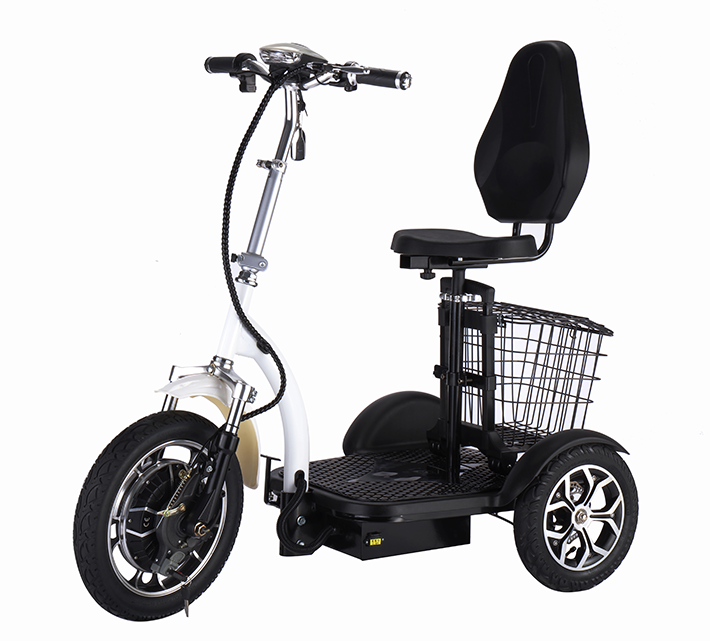
- 3-wheel variant: Ultra-tight turning radius, maximum legroom for users with leg braces or prosthetics; perfect for supermarkets, shopping malls, and indoor residential navigation
- 4-wheel variant: Wider wheelbase for lateral stability, reduced tipping risk on uneven pavement, shallow curbs, and grass
- Core specs: 500–600W motor, optional 48V 12Ah/20Ah battery, 15–30km single-charge range
- Standout accessibility features: Swivel adjustable seat, flip-up armrests for easy side entry, front storage basket for medical supplies or groceries
- Target buyers: General retail mobility stores, local disability support service fleets
Heavy-Duty Multi-Seat Tricycle Scooters
Engineered for bariatric disabled users, long-distance outdoor travel, or users who require a caregiver companion seat.
- Reinforced thick steel chassis, pneumatic large-diameter tires, full front/rear shock absorption
- Power performance: 600–1000W high-torque motor, supports up to 30-degree hill climbing
- Load capacity: Single seat up to 200kg; dual-seat models support two adult riders simultaneously
- Extended utility: Rear storage trunk, high waterproof IPX4 electrical components, long-range 48V 20Ah battery (30–50km per charge)
- Primary market demand: Rural disabled communities, park tourism rental fleets, senior residential care institutions
Premium Outdoor 4-Wheel Mobility Scooters
Top-tier medical-grade mobility devices for users with permanent moderate-severe mobility impairment, designed for all-weather outdoor daily use.
- Full independent suspension system, anti-shock ergonomic leather orthopedic seat with headrest
- Complete safety suite: LED front/rear lighting, turn signal indicators, rearview mirrors, anti-tip stabilizers, fail-safe electromagnetic braking
- Customizable accessories: Oxygen tank bracket, walking cane holder, lockable rear storage box
- Compliance standard: Fully certified for medical device classification under EU MDR, US FDA Class II guidelines
3. Key Performance Metrics to Compare All Scooter Variants
When evaluating wholesale inventory options for disabled users, standardize comparisons across these critical performance benchmarks to avoid mismatched market supply:
表格
| Performance Metric | Entry Portable Scooter | Mid-Size Daily Scooter | Heavy-Duty Tricycle | Premium Outdoor Scooter |
|---|---|---|---|---|
| Motor Power | 350–500W | 500–600W | 600–1000W | 800–1000W |
| Max Climbing Angle | 8–12° | 12–20° | 20–30° | 15–25° |
| Single-Charge Range | 10–18km | 15–30km | 30–50km | 25–40km |
| Max Load Capacity | 100–120kg | 130–160kg | 180–220kg | 150–180kg |
| Total Unit Weight | 25–38kg | 40–65kg | 70–110kg | 65–90kg |
| Waterproof Rating | IPX3 | IPX4 | IPX4 | IPX5 |
| Standard Brake Type | Electromagnetic auto-brake | Dual electromagnetic + drum brake | Disc + electromagnetic dual brake | Four-wheel hydraulic brake |
4. How Terrain & End-User Physical Needs Match Each Scooter Variant
Sourcing misaligned scooter models for regional terrain and disability profiles creates excess dead stock. This matching framework helps buyers map inventory to local customer demands:
Indoor-Only Disabled Users (Apartment, Care Homes, Malls)
Primary limitations: Narrow door frames, tight corner turns, limited storage space, minimal outdoor exposure Recommended models: 3-wheel portable foldable scooters Critical non-negotiable features: Narrow body width under 60cm, swivel seat, flip armrests, lightweight foldable frame
Mixed Indoor & Urban Pavement Use
Primary limitations: Uneven sidewalk curbs, occasional grass or gravel pathways, daily short-distance errands Recommended models: Mid-size 4-wheel daily mobility scooters Critical non-negotiable features: Balanced stability and maneuverability, removable batteries for indoor charging, front storage basket for medical equipment
Rural / Suburban Outdoor-Exclusive Disabled Users
Primary limitations: Steep driveways, gravel/unpaved roads, long-distance trips, variable weather exposure Recommended models: Heavy-duty tricycles or premium 4-wheel outdoor scooters Critical non-negotiable features: High climbing capacity, full shock suspension, large pneumatic tires, extended battery range, full lighting package for low-light travel
Bariatric Disabled Users or Dual-Rider Caregiver Trips
Primary limitations: High body weight requiring reinforced frame, companion travel support, long outdoor excursions Recommended models: Dual-seat heavy-duty trike scooters Critical non-negotiable features: Reinforced steel chassis, widened padded seating, high load threshold, dual independent shock absorption
Travel-Focused Disabled Users (Air, Road Trips, Vacations)
Primary limitations: Vehicle trunk storage, airline cargo weight restrictions, temporary accommodation storage limits Recommended models: Ultra-light portable foldable mobility scooters Critical non-negotiable features: Detachable lightweight lithium batteries, split folding frame, total weight under 38kg
5. Critical Safety & Comfort Features Disabled Riders Require
Unlike recreational scooters, disability mobility devices must include accessibility-focused safety and ergonomic features to reduce injury risks and improve long-term user compliance. Wholesale buyers should verify all below features before bulk order confirmation:
Mandatory Safety Systems
- Fail-safe electromagnetic auto-braking: Automatically engages brake when user releases throttle, eliminating rollaway risk for users with limited grip control
- Anti-tip rear stabilizer wheels: Prevents backward tipping during steep hill climbing or fast stops
- Full visibility lighting suite: Headlight, rear brake lights, turn signal indicators, reflective strips for sidewalk and road travel compliance
- Low center-of-gravity chassis design: Reduces lateral tipping risk on uneven ground for balance-impaired disabled users
- Waterproof sealed electrical panels: Prevents short-circuit failure during rain exposure for all-weather outdoor riders
Accessibility & Comfort Ergonomics
- Swivel 360° adjustable seat: Eliminates painful twisting for users with spinal injuries to mount/dismount the scooter
- Flip-up padded armrests: Creates wide side entry space for users with limited leg mobility or wheelchair transfer needs
- Orthopedic high-density foam seating with lumbar support: Reduces pressure sores for users who spend multiple hours seated daily
- Oversized, textured throttle grips: Easy manipulation for disabled users with arthritis, reduced finger strength, or neuromuscular hand impairment
- Adjustable seat height and backrest tilt: Custom fit for users with prosthetic limbs, leg length discrepancies, or chronic back pain
Utility Add-Ons That Boost Retail Conversion
- Front wire storage basket for medication, shopping bags, or walking aids
- Lockable rear storage trunk for personal valuables
- Optional oxygen tank bracket for users with respiratory disabilities
- Walking cane or crutch mounting holder
- USB charging port for mobile medical monitoring devices
6. Global Market Certification & Import Compliance Breakdown
Customs clearance delays, seized shipments, and product market bans are costly risks for mobility scooter importers. Each major global region enforces distinct certification rules for scooters classified as medical accessibility devices, which buyers must validate with manufacturers before placing bulk orders.
European Union & UK Markets
- EU Core Certification: CE marking compliant with MDR 2017/745 medical device regulation, EN 12184 mobility equipment safety standard, LVD low voltage, EMC electromagnetic compatibility directives
- Additional requirements: UN38.3 lithium battery safety testing, RoHS hazardous material compliance, UDI unique device traceability labeling
- Post-Brexit UK: Separate UKCA marking mandatory for domestic retail distribution, CE marking alone no longer accepted
United States & Canada
- USA: FDA Class II medical device registration + 510(k) pre-market clearance for disability mobility scooters; UL 2271 lithium battery safety certification, FCC electromagnetic compatibility testing
- Canada: Health Canada medical device licensing, CSA battery safety certification
Australia, New Zealand & Southeast Asia
- Australia: TGA medical device approval, AS/NZS 15194 mobility vehicle safety standard
- Southeast Asia (Malaysia, Thailand, Singapore): COC local conformity certification, UN38.3 battery testing mandatory for all lithium-powered mobility imports
- Middle East (Saudi Arabia, UAE): GCC/SASO regional conformity certification
Key Buyer Compliance Checklist
- Request full technical documentation, test lab reports, and declaration of conformity from manufacturers
- Confirm battery UN38.3 certification for sea/air freight shipping clearance
- Verify medical device classification documentation if targeting healthcare, charity, or government tender clients
- Confirm product labeling meets regional language, traceability, and safety warning requirements
7. Advanced Sourcing Tips for Distributors & Institutional Buyers
Tip 1: Align MOQ with Market Segment Demand
Lightweight portable foldable scooters typically carry lower minimum order quantities, ideal for small retail mobility stores or new market trial inventory. Heavy-duty dual-seat trikes carry higher MOQs, best suited for large institutional fleets, tourism rental businesses, or established wholesale distributors with broad regional coverage. Confirm flexible mixed-container MOQ terms with manufacturers to diversify inventory without overstocking single models.
Tip 2: Evaluate Manufacturer Structural & Electronic R&D Advantages
Suppliers with decades of steel/aluminum frame production and in-house electronic control system development deliver more consistent long-term product quality. Prioritize factories with dedicated mobility scooter testing labs for load-bearing, hill climbing, waterproof, and long-duration endurance testing to reduce post-sale warranty claims.
Tip 3: Negotiate Customization Options for Local Market Differentiation
Work with manufacturers to adjust specifications to match regional regulations: limit maximum speed to comply with local sidewalk traffic laws, swap battery capacity to align with consumer range preferences, add region-specific safety lighting, or customize frame colorways to match local retail brand aesthetics. Custom packaging with multilingual user manuals also reduces customer support overhead post-import.
Tip 4: Map After-Sales Support Before Bulk Order Placement
Confirm spare parts supply lead times for core components (batteries, motor assemblies, brake systems, seating frames). Long-distance importers should prioritize manufacturers that offer consolidated spare parts container shipments alongside scooter orders to cut down separate freight costs and inventory downtime for repair service fleets.
8. Frequently Asked Questions for Bulk Buyers
Q1: What is the difference between a consumer electric scooter and a medical mobility scooter for disabled users?
A: Consumer recreational scooters prioritize lightweight frames and speed without mandatory fall-protection safety systems or orthopedic ergonomics. Disability mobility scooters are engineered to medical device safety standards, featuring anti-tip stabilizers, fail-safe braking, adjustable accessibility seating, and load-tested reinforced frames to accommodate physical impairment limitations. Most regulated markets classify disability scooters as medical equipment, requiring strict certification unavailable for generic consumer e-scooters.
Q2: Which model yields the highest profit margin for retail mobility stores targeting disabled customers?
A: Mid-size 4-wheel daily mobility scooters deliver the optimal balance of wholesale cost, retail markup potential, and broad consumer demand. Portable foldable models carry lower unit price points with thinner margins, while heavy-duty trikes require higher upfront inventory investment with slower retail turnover rates.
Q3: How do lithium battery shipping regulations impact import logistics costs?
A: All lithium-ion mobility scooter batteries require UN38.3 safety testing documentation for air or sea freight. Non-certified battery shipments face carrier rejection or customs seizure. Manufacturers that integrate detachable battery designs allow separate battery packaging, reducing dangerous goods surcharges for international freight shipments.
Q4: Can mobility scooters for disabled users be supplied to government disability support tender programs?
A: Yes, but tender bids require full medical device certification (CE MDR, FDA, TGA, etc.), complete technical test reports, and factory ISO 13485 medical quality management system certification. Buyers should source manufacturers with prior government tender supply experience to streamline bid documentation preparation.
Q5: How to reduce product return rates from disabled end customers?
A: Prioritize sourcing models with fully adjustable ergonomic components (seat height, armrest width, throttle sensitivity). Provide retail partners with standardized user sizing guides to match rider weight, height, and disability type to appropriate scooter models during customer consultations. Stock core replacement spare parts locally to resolve minor issues without full unit returns.
9. Conclusion
Mobility scooters designed for disabled users represent a high-growth, low-competition niche for global distributors, retail mobility operators, and institutional purchasers, driven by rising global demand for independent accessibility solutions. Successful inventory sourcing hinges on three core pillars: matching scooter mechanical performance to regional terrain and disability user profiles, validating full regional import certification before bulk orders, and prioritizing models built with medical-grade safety and accessibility ergonomics.
By leveraging the category breakdown, performance comparison framework, and compliance guidance outlined in this guide, buyers can eliminate costly inventory mismatches, streamline customs clearance, and deliver reliable, user-focused mobility products that build long-term customer loyalty and consistent wholesale profit margins.
Post time: Aug-12-2026