


Mobility Scooter Turning Radius and Indoor Clearance
For importers and mobility dealers, turning radius is the specification that decides whether a scooter can actually be used in the places customers live. A unit that passes every power and range test still fails in the field if it cannot get through an apartment doorway or turn inside a bathroom. This guide explains how to read turning-circle figures, how three-wheel and four-wheel chassis behave in tight spaces, and how to verify dimension claims before you commit to a container order. Treat maneuverability as a product-defining requirement, not a footnote on a spec sheet.
Why turning radius drives indoor fit
Turning radius is the distance from the centre of the turning circle to the outer edge of the scooter’s path at full steering lock. In practical terms it sets the minimum clear width a unit needs in order to rotate. A scooter with a tight circle can pivot inside a narrow hallway; one with a wide circle needs an open area the size of a small car bay simply to change direction.
For B2B buyers this is the specification that generates the most post-sale complaints. Dealers see returns not because a motor failed but because the product could not pass through a standard interior door or turn around in a care-home room. When you shortlist models, request the turning radius figure together with overall length, overall width and seat height, then map those numbers onto the real environments your customers describe. A scooter that fits more homes sells through more channels, and indoor maneuverability is usually the first filter applied by DME dealers, retirement-living operators and home-care buyers alike.
How turning circle figures are measured
Suppliers do not all measure the same way, so two figures that look identical on paper can describe different real-world behavior. Ask your factory which reference point they use: the outer front corner, the outer edge of the rear tyre, or the farthest point of the seat or armrest. A measurement taken to the chassis alone will understate the space the whole unit occupies once a rider is seated.
- Turning circle versus turning radius. Some sheets quote a full circle diameter, others a radius. Confirm which one you are reading before you compare models; a 1.2 metre radius describes a 2.4 metre circle.
- Full lock condition. The figure should be recorded with the steering at maximum lock and the scooter unloaded, or with a defined test load clearly stated.
- Seat rotation excluded. A swivel seat can help a rider exit, but it does not reduce the space the base needs to turn. Keep the two concepts separate.
Dimension tolerance is the next item to pin down. Production scooters vary a few millimetres between batches, and accessories such as rear baskets or wider armrests add width. Specify the maximum accepted overall width and turning circle in your purchase contract rather than accepting a nominal catalogue number.
Three-wheel versus four-wheel maneuverability
The wheel layout is the single biggest influence on indoor agility, and it is where three-wheel and four-wheel models diverge most sharply.
Three-wheel scooters use a single front wheel and a steering mechanism that lets the nose swing around a tight pivot. They typically achieve a smaller turning circle, which makes them the default choice for apartments, assisted-living rooms and crowded retail aisles. The trade-off is lateral stability: with only two rear contact points, the unit is more sensitive to side slopes, sharp turns at speed and uneven surfaces. For indoor, flat-floor use that compromise is usually acceptable, and it is why this layout dominates the senior-care segment.
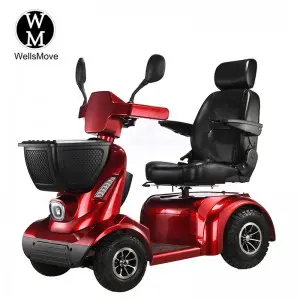
Four-wheel scooters spread their footprint across four corners. They feel more planted and handle outdoor pavement and gentle gradients with greater confidence, but the wider front track and longer wheelbase increase the turning circle. A four-wheel model that is comfortable on a pavement may need a substantially wider corridor to reverse out of a lift or a small bedroom, so it should never be specified on turning performance alone.
- Match three-wheel layouts to indoor-focused customers navigating doors, lifts and tight furniture.
- Position four-wheel layouts where outdoor stability is the priority and indoor turning space is available.
- Offer both in a range so dealers can upsell based on the customer’s actual floor plan rather than a single spec.
Tip: Never quote a turning radius to a customer without also stating the overall width, because a tight circle on a very wide chassis still will not pass a standard interior door.
Door width, corridors and thresholds
Indoor clearance is a chain of constraints, and the narrowest link decides whether the product works. Start with the clear opening of a standard interior door, then work through corridor width, lift car dimensions and any thresholds or floor transitions the rider will cross.
Build a clearance worksheet for every market you serve. Record the clear door opening, the corridor width at its narrowest point, the lift door width and the lift car internal depth. Compare those against the scooter’s overall width, its turning circle and the height of its footplate above the floor. A raised footplate can catch on a threshold even when the chassis itself is narrow enough to pass.
- Doorways. Add a comfort margin to the measured scooter width; a rider needs hand clearance on both sides, not just a theoretical fit.
- Corridors. A scooter that can drive down a corridor may still be unable to turn at its end. Check both travel and rotation.
- Lifts. Confirm the unit fits within the lift car and can rotate inside it, since many riders reverse in and cannot turn around.
- Thresholds. Note the maximum step height the front wheels can climb and require the supplier to state it in writing.
Verifying dimension claims before you order
Catalogue figures are a starting point, not a guarantee. The most reliable approach is to require a dimensioned drawing and then confirm it against a physical sample. Many suppliers translate a brochure from another market without rechecking the numbers after a component change, so a figure that was accurate two years ago may no longer describe the current production unit. Treat every dimension as a claim that needs independent confirmation before it reaches a customer-facing specification sheet.
When you receive a sample, test it in a realistic mock-up rather than in an open warehouse. Set up a frame that matches a standard interior door opening and a corridor of the width your customers actually report, then have a rider of average build drive through and turn around. This simple exercise reveals problems that no spreadsheet will show, such as armrests clipping a door frame or the front shroud extending past the measured wheel line during a tight turn. Record the result on video and share it with the factory so any correction is grounded in observed behavior.
- Request a technical drawing showing overall length, width, height, seat height, turning circle and ground clearance in millimetres.
- Ask whether dimensions are stated with the seat fitted and the battery pack installed, since removing either changes the real footprint.
- Measure a pre-production sample yourself at full steering lock, with the seat and any optional accessories attached.
- Specify the accepted tolerance in the purchase order and state who pays if a production batch falls outside it.
- Check that folding or disassembling mechanisms do not add width when the unit is reassembled incorrectly.
Importer selection checklist
When you evaluate a supplier, treat indoor maneuverability as a scored criterion alongside price and compliance. A practical checklist keeps the decision objective and repeatable across candidates:
- Turning circle stated in writing, with the measurement method clearly defined.
- Overall width and length confirmed on a sample, including fitted accessories.
- Both three-wheel and four-wheel variants available from one platform.
- Step height, ground clearance and maximum safe incline documented.
- Replacement parts for steering and front-wheel assemblies readily available.
- Warranty terms that cover steering components, not just the motor and battery.
- Clear escalation path for a batch that misses the agreed dimensional tolerance.
Testing and compliance considerations
Turning performance intersects with safety testing, so do not treat it in isolation. Steering geometry affects stability, and any change to wheelbase or front-track width can influence how a unit behaves during tilt and braking assessments. Ask the supplier which stability and braking standards the model was tested against, and whether the reported turning figure came from the same configuration that was submitted for testing.
Documentation matters as much as the physical test. Keep the dimension drawing, the test report and the sample measurement record together in your technical file. If a market authority or a large retail buyer asks why a product is suited to indoor use, that file is your evidence. It also protects you when a dealer claims the delivered units differ from the approved sample.
FAQ
What is a good turning radius for indoor use? There is no single number that fits every building. Compare the quoted turning circle against the narrowest space the rider must rotate in, and always allow a comfort margin rather than choosing the smallest figure on paper.
Are three-wheel scooters always better indoors? They usually turn more tightly, but the final decision depends on the doorway width, the rider’s stability needs and how much time is spent outdoors. A three-wheel model that cannot handle a local ramp may be a poor choice despite its small circle.
Does a swivel seat reduce the turning circle? No. It helps the rider get on and off, but the base still needs the same clear floor area to rotate. Evaluate the two features separately.
How should I compare figures from different suppliers? Confirm whether each figure is a radius or a full diameter, what reference point was measured, and whether it includes the seat and accessories. Normalize the numbers before you rank models.
Should I specify dimensions in the purchase contract? Yes. State the maximum overall width and turning circle, the accepted tolerance and the remedy for a batch that falls outside it. This turns a marketing claim into a contractual requirement.
Related Pages
- Mobility Scooter Wholesale: Complete Buyer’s Guide 2026
- Mobility Scooter Factory Audit Guide
- CE Certification for Mobility Scooters: Complete Guide
- How to Get the Best Price on Mobility Scooters
Post time: Nov-11-2026