

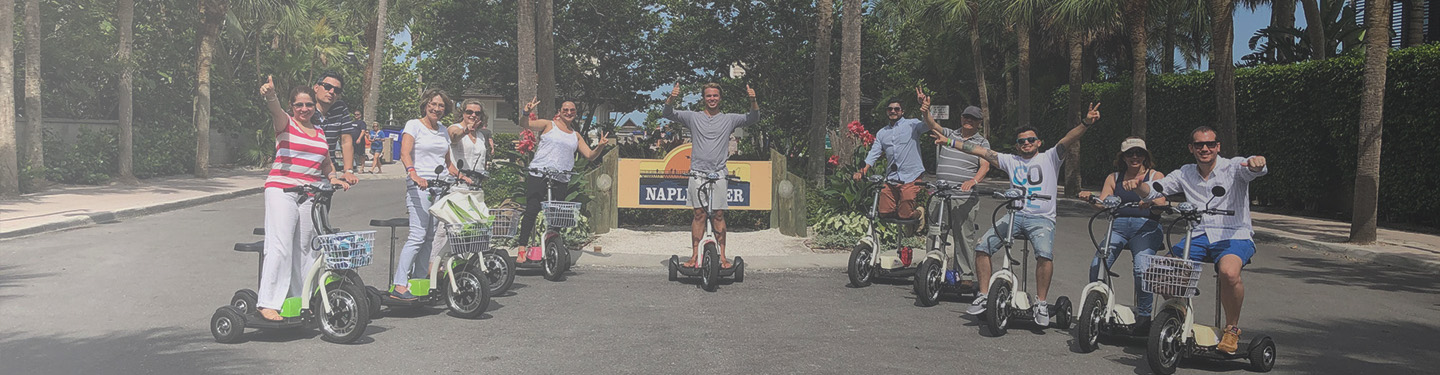
Electric Mobility Scooter Types Explained
Table of Contents
- Understanding Core Mobility Scooter Classification Logic
- Exploring The Four Main Mobility Scooter Categories
- Key Performance Metrics To Compare Across All Scooter Types
- How Terrain & End-User Groups Match Each Scooter Variant
- Bulk Procurement Tips By Scooter Model Line
- Frequently Asked Questions For Wholesale Buyers
- Conclusion: Match Inventory To Market Demand Profiles
Global demand for electric mobility scooters continues rising year over year, driven by aging population demographics, growing accessibility legislation for disabled users, booming tourist rental fleets, and institutional procurement for assisted living and medical care facilities. For distributors, retail chain operators, and bulk importers, understanding the distinct mobility scooter types is the foundation of profitable inventory planning. Each category carries unique performance limits, target user groups, pricing tiers, logistics costs, and regional compliance requirements. Choosing mismatched models for your local market leads to slow inventory turnover, compressed profit margins, and customer dissatisfaction.
This guide breaks down every mainstream mobility scooter classification, compares core specifications side-by-side, and delivers actionable insights tailored exclusively for B2B wholesale buyers sourcing mobility equipment for resale or commercial fleet use.
1. Understanding Core Mobility Scooter Classification Logic
Mobility scooters are not sorted by aesthetics alone. Industry suppliers and regulatory bodies group units based on four decisive functional criteria, which all bulk buyers should prioritize during product selection:
- Wheel configuration (3-wheel vs 4-wheel)
- Portability design (foldable lightweight vs fixed-frame heavy-duty)
- Load capacity and motor power output
- Primary operating environment (indoor compact travel vs long-distance outdoor all-terrain)
Each classification directly impacts production costs, shipping volume, certification eligibility, and end-customer use scenarios. For example, ultra-light foldable travel scooters have lower container loading weight and simpler cross-border certification, while heavy-duty multi-passenger tricycles require robust structural testing and larger shipping footprints.
2. Exploring The Four Main Mobility Scooter Categories
2.1 Portable Lite Foldable Mobility Scooters


Portable Lite Foldable Scooter
Portable lite mobility scooters are engineered around compact disassembly and foldable frames, built for frequent transportation inside vehicle trunks, elevators, trains, and cruise ships. These represent the entry-level product line for retail and travel-focused distributors.
Core Defining Features
- Ultra-light aluminum alloy frames, full unit weight ranging 45–60kg
- Quick one-step folding mechanism; split removable lithium battery packs for airline compliance
- Low-power 250W–350W rear brushless motors, 10–15 degree climbing capability
- 3-wheel narrow body design for ultra-tight turning radius, ideal for indoor navigation
- Small 8–10 inch rubber tires, optimized for flat indoor floors and smooth sidewalks
- Standard 48V 12Ah lithium batteries, delivering 15–25km single-charge range
Ideal Buyer & End-User Fit
Perfect for general retail stores, airport tourist kiosks, and medical supply shops targeting active seniors, frequent travelers, and users who only require short-distance indoor or neighborhood trips. Wholesale advantages include lower MOQ, compact container packing, and broad cross-market certification compatibility (CE, UL, IEC battery safety standards).
Limitations To Note For Inventory Planning
Limited weight load capacity (max 120kg), weak performance on steep slopes or uneven gravel terrain, minimal storage space, and fewer premium comfort add-ons. Not suitable for rental fleets operating in hilly suburban or rural areas.
2.2 Single-Person Personal Mobility Trikes

Single Person Personal Trike

Classic Personal Mobility Trike
Single-person 3-wheel personal mobility trikes strike a balanced middle ground between portability and outdoor performance, the most versatile mid-tier model line for global wholesale buyers. This category accounts for the largest share of consumer mobility scooter retail sales across North America, Europe, and Southeast Asia.
Core Defining Features
- Reinforced steel/aluminum hybrid frames, weight 60–85kg
- 500W differential brushless motors with 30-degree maximum climbing capacity
- 48V 12Ah/20Ah dual battery options, adjustable range from 25–40km per full charge
- Front wire mesh shopping basket and under-seat storage compartments as standard
- Upgraded front suspension forks to absorb minor pavement bumps
- Adjustable padded captain seats with detachable armrests for easy entry and exit
Ideal Buyer & End-User Fit
Suited for independent medical retailers, assisted living facility bulk orders, small tourist rental operators, and supermarket mobility loan fleets. Target end users include daily errand-running seniors, partially disabled users, and casual recreational riders. Mixed container orders combining portable lite and personal trike models create balanced inventory covering low and mid-budget customer segments.
Limitations To Note For Inventory Planning
Three-wheel architecture delivers less lateral stability than four-wheel heavy-duty variants when navigating sharp turns at speed. Not recommended for users requiring maximum balance confidence or off-road grass/gravel travel.
2.3 Four-Wheel Heavy-Duty Mobility Scooters

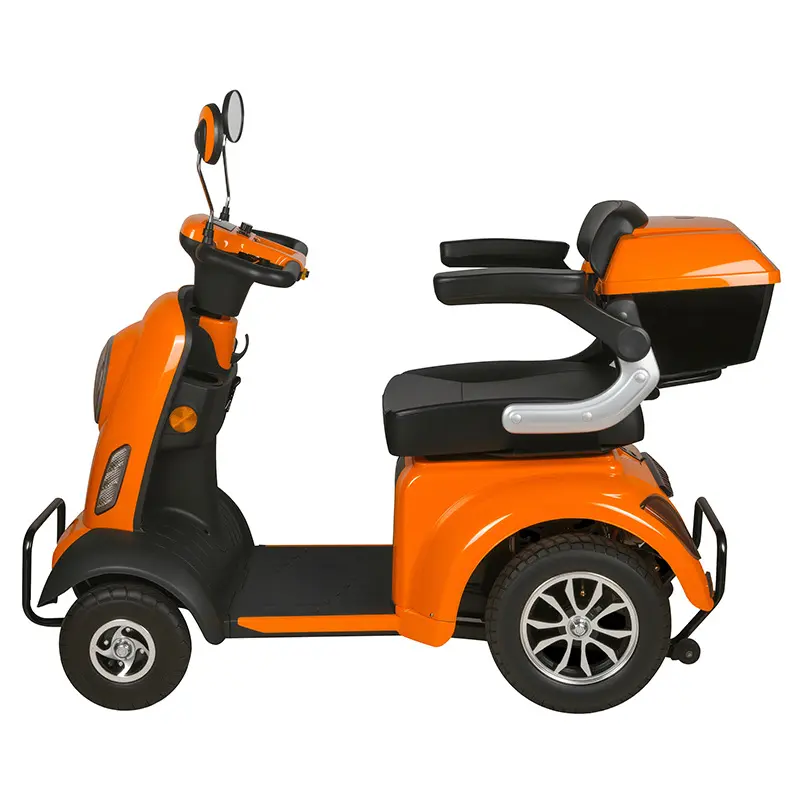
4 Wheel Heavy Duty Scooter

Premium 4 Wheel Mobility Scooter
Four-wheel heavy-duty mobility scooters prioritize stable outdoor performance, long-distance endurance, and maximum rider comfort, positioned as the premium high-margin product line for B2B buyers.
Core Defining Features
- Wide four-wheel wheelbase with integrated anti-tip rear wheels for full lateral stability
- 600W–800W high-torque motors with reinforced gearboxes, handling consistent steep inclines
- Larger 10–12 inch all-terrain tires paired with full front and rear shock suspension
- Extended 48V 20Ah lithium batteries delivering 35–50km single-charge driving range
- Oversized padded ergonomic seats with headrests, adjustable backrest angles
- Rear lockable storage trunk, integrated LED turn signals, brake lights, and high-beam headlights
- Max load capacity up to 150kg for larger body frame users
Ideal Buyer & End-User Fit
Best for premium medical equipment distributors, long-term tourist rental companies, retirement village fleets, and regional mobility specialist retailers catering to users with limited balance or regular long-distance outdoor travel. Higher unit profit margins offset slightly higher shipping costs compared to three-wheel models.
Limitations To Note For Inventory Planning
Larger overall dimensions reduce elevator and narrow doorway accessibility; full frame weight exceeds 100kg, making vehicle trunk transportation without disassembly difficult. Small retail locations with limited floor space should limit heavy-duty four-wheel stock volume.
2.4 Multi-Passenger Heavy-Duty Mobility Tricycles

Two-Passenger Heavy Duty Trike
Multi-passenger mobility trikes are commercial-grade workhorses built for shared riding, heavy cargo hauling, and high-traffic rental environments, the primary commercial fleet product line for bulk institutional buyers.
Core Defining Features
- Extended three-wheel chassis with dual padded seating for two adult riders
- 500W–1000W high-torque differential motors supporting 30-degree climbing angles
- Dual storage solutions: large front shopping basket + expandable rear cargo compartment
- Heavy-duty drum/disc combined braking system for safe loaded stopping
- 48V 20Ah standard battery configuration, 30–40km range under full two-person load
- Reinforced anti-corrosion steel frames engineered for daily repeated commercial use
Ideal Buyer & End-User Fit
Target customers include tourist attraction rental operators, security patrol fleets, warehouse campus transit, assisted living group transport, and coastal resort mobility rental businesses. Bulk institutional orders for retirement communities represent consistent large-volume procurement opportunities.
Limitations To Note For Inventory Planning
Largest shipping footprint of all mobility scooter categories, raising per-unit ocean freight expenses. Strict regional passenger transport certification rules apply in EU and North American markets, requiring pre-shipment document verification to avoid customs delays.
3. Key Performance Metrics To Compare Across All Scooter Types
For wholesale buyers evaluating product lines, standardizing performance comparisons eliminates guesswork when matching models to market demand. This reference table summarizes critical specs across each core category:
表格
| Scooter Type | Typical Motor Power | Max Climbing Angle | Standard Battery | Single-Charge Range | Max Load Capacity | Primary Use Environment |
|---|---|---|---|---|---|---|
| Portable Lite Foldable | 250W–350W | 10–15° | 48V 12Ah Li-ion | 15–25km | 120kg | Indoor, flat urban sidewalks, travel transport |
| Single-Person Personal Trike | 500W | 30° | 48V 12Ah/20Ah Li-ion | 25–40km | 130kg | Daily neighborhood errands, light outdoor travel |
| 4-Wheel Heavy-Duty Scooter | 600W–800W | 30° | 48V 20Ah Li-ion | 35–50km | 150kg | Long-distance outdoor, uneven pavement, hills |
| Multi-Passenger Heavy-Duty Trike | 500W–1000W | 30° | 48V 20Ah Li-ion | 30–40km | 200kg (dual rider) | Commercial rental, campus patrol, group transport |
Critical Component Breakdown For Buyers
Motor Systems
Brushless DC differential motors are standard across all premium lines, delivering quieter operation, longer service life, and better torque on inclines compared to brushed alternatives. Budget portable models may use basic rear hub motors without differential gearing, reducing turning stability for low-cost market segments.
Battery Technology
Two primary battery options exist for bulk procurement:
- Lithium-ion: Lighter weight, faster charging, 300+ full charge cycles, airline transport compliant. Higher upfront unit cost but lower long-term customer replacement claims. Preferred for portable and premium heavy-duty lines.
- Lead-acid: Lower factory wholesale price, stable performance in moderate climates. Heavier frame weight limits portability, shorter cycle life, ideal for fixed commercial multi-passenger fleets with stationary charging stations.
Safety Systems (Non-Negotiable For Global Compliance)
All export-ready mobility scooters must include electromagnetic auto-cutoff brakes, anti-tip wheel structures, audible safety horns, and front/rear lighting assemblies to meet EU CE, US FCC, and medical mobility equipment regulatory standards. Distributors should confirm full certification documentation prior to placing bulk orders to prevent customs seizure.
4. How Terrain & End-User Groups Match Each Scooter Variant
Sourcing inventory without mapping local terrain and customer demographics creates slow-selling stock. Below is a simplified matching framework for wholesale buyers:
Flat Urban Residential Markets (Cities, Suburbs With Paved Sidewalks)
- Primary inventory focus: Portable Lite Foldable + Single-Person Personal Trikes
- Secondary stock: Limited volume four-wheel heavy-duty models for premium customer subset
- Key selling angles for retail staff: compact storage, easy car transport, low daily operation noise
Hilly Suburban & Rural Markets (Sloped Streets, Gravel Paths, Park Trails)
- Primary inventory focus: Four-Wheel Heavy-Duty Mobility Scooters
- Secondary stock: High-power 500W personal trikes with upgraded suspension
- Key selling angles for retail staff: steep slope climbing power, all-terrain tire traction, long battery range
Commercial Rental & Institutional Markets (Tourist Resorts, Retirement Villages, Campus Patrol)
- Primary inventory focus: Multi-Passenger Heavy-Duty Tricycles + durable single-person trikes
- Secondary stock: Four-wheel heavy-duty units for premium rental packages
- Key selling angles for fleet managers: reinforced commercial frames, spare parts availability, dual passenger revenue potential
Travel & Medical Retail Markets (Airport Kiosks, Pharmacy Mobility Sections)
- Primary inventory focus: Ultra-portable foldable lite scooters
- Secondary stock: Compact single-person trikes for mid-budget shoppers
- Key selling angles for retail staff: airline-approved lithium batteries, fold-and-store design for vehicle transport
5. Bulk Procurement Tips By Scooter Model Line
Portable Lite Foldable Scooters
- Negotiate mixed-color bulk discounts; lighter neutral shades (white, matte black) have universal cross-market appeal
- Prioritize suppliers offering detachable battery certification documents for air freight compliance
- Consolidate orders with personal trike units to qualify for full container volume tiered pricing
Single-Person Personal Mobility Trikes
- Split battery capacity inventory (12Ah budget units + 20Ah long-range premium units) to capture two price tiers
- Add optional accessory bundles (replacement baskets, padded seat covers) for upsell profit opportunities
- Request standardized multi-language user manuals for cross-border retail resale
Four-Wheel Heavy-Duty Mobility Scooters
- Allocate smaller inventory batches unless your market has high demand for long-distance outdoor riding
- Lock in spare parts supply agreements for brake assemblies, suspension shocks, and large tires
- Confirm local market medical equipment certification requirements before mass production orders
Multi-Passenger Heavy-Duty Tricycles
- Target large institutional tender orders (retirement communities, resort fleets) for highest volume discounts
- Calculate full landed cost including oversized container loading fees during budget planning
- Specify reinforced commercial-grade wiring and frame welding for heavy daily fleet use
6. Frequently Asked Questions For Wholesale Buyers
Q: Which mobility scooter type delivers the highest profit margin for retail distributors?
A: Four-wheel heavy-duty mobility scooters carry the largest per-unit gross margin, followed by multi-passenger commercial trikes. Portable foldable models drive sales volume with thinner profit per unit, best used as entry-level loss leaders to draw retail foot traffic.
Q: Are three-wheel mobility scooters less safe than four-wheel variants for end customers?
A: Three-wheel designs offer reduced lateral stability during high-speed sharp turns, making them less ideal for users with balance impairments or frequent off-pavement travel. For indoor flat-surface use, three-wheel scooters meet global safety standards and remain the most maneuverable option.
Q: Can I mix multiple scooter types within a single shipping container to lower logistics costs?
A: Most manufacturers support mixed-model full container loads (FCL), combining portable lite, single-person trike, and limited heavy-duty stock. Mixed shipments reduce per-unit ocean freight expenses and allow balanced inventory without overstocking one product line.
Q: What certification documents must I receive for mobility scooters to clear customs in the EU and US?
A: Mandatory documentation includes CE conformity marking, lithium battery IEC 62133 safety test reports, frame structural load testing certificates, and electromagnetic compatibility (EMC) documentation. Medical-use variants require additional FDA or local medical device compliance paperwork.
Q: Which battery type should I prioritize for wholesale orders targeting tourist rental fleets?
A: Lithium-ion batteries are recommended for rental businesses, as their lighter weight simplifies scooter transport between rental locations and faster charging speeds reduce customer wait times during peak tourist seasons.
7. Conclusion: Match Inventory To Market Demand Profiles
Electric mobility scooter categories are not interchangeable, and successful B2B wholesale sourcing hinges on aligning your inventory mix with your regional terrain, end-user demographics, and customer spending tiers. Portable foldable scooters capture entry-level travel-focused shoppers, single-person trikes deliver consistent mid-market sales volume, four-wheel heavy-duty units drive premium high-margin revenue, and multi-passenger trikes unlock large commercial fleet tender opportunities.
As global mobility aid demand expands through 2026 and beyond, distributors that maintain a balanced cross-category product lineup will capture broader customer segments and mitigate inventory turnover risks. When partnering with manufacturers, prioritize suppliers with full metal frame fabrication, in-house electronic system development, and complete global certification support to streamline your cross-border procurement and resale operations.
Post time: Aug-05-2026