

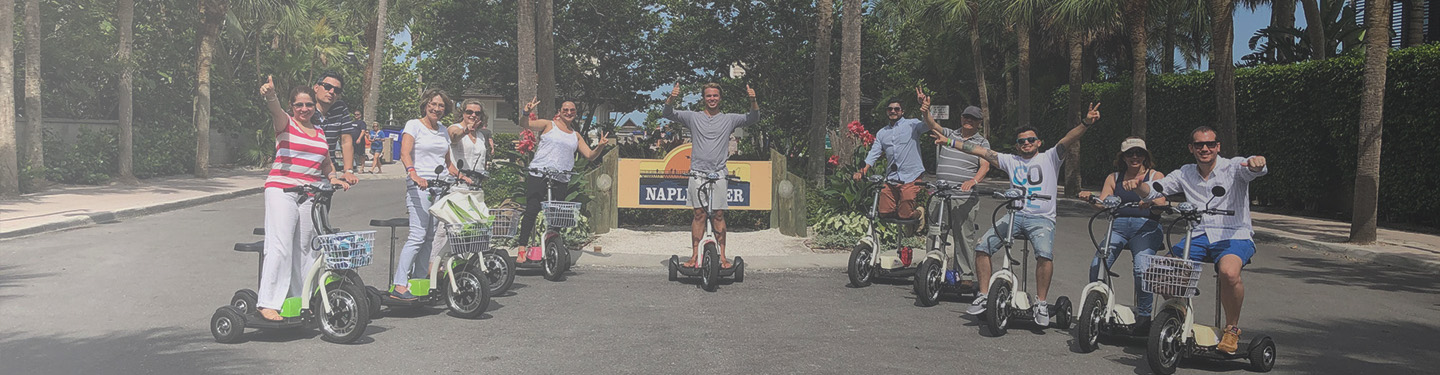
Best Mobility Scooters for Seniors: Wholesale Buyer Guide
Table of Contents
- Introduction: Why Senior Mobility Scooters Are a High-Growth Wholesale Category
- Core Buyer Personas: Who Serves the Senior Mobility Market Globally
- Key Product Specifications to Prioritize When Sourcing Elderly Mobility Trikes
- 4 Main Mobility Scooter Series for Different Wholesale Business Models
- Regional Compliance & Certification Rules Every Bulk Buyer Must Follow
- Step-by-Step Bulk Sourcing Checklist to Avoid Costly Import Mistakes
- How to Evaluate a Reliable Mobility Scooter Manufacturer
- Cost Breakdown: Calculating True Total Landed Cost for Wholesale Orders
- Common Bulk Procurement Mistakes & How to Mitigate Risks
- Post-Delivery Support & Spare Parts Planning for Long-Term Profit
- Final Takeaways for New & Experienced Wholesale Mobility Buyers
Introduction: Why Senior Mobility Scooters Are a High-Growth Wholesale Category
Core Buyer Personas: Who Serves the Senior Mobility Market Globally
- Independent retail distributors: Target general elderly consumers, balance cost and basic safety performance, require multiple entry-level and mid-range models
- Healthcare & assisted living facility purchasers: Prioritize medical-grade certification, stability, ergonomic seating and long-term warranty coverage
- Tourism rental operators: Need lightweight, portable foldable scooters with simple maintenance and interchangeable spare parts
- Property & campus security fleets: Demand heavy-duty trikes with high climbing capacity, durable frames and extended battery range
- Disability support nonprofits: Focus on affordable, easy-to-operate low-speed models with straightforward control panels
Key Product Specifications to Prioritize When Sourcing Elderly Mobility Trikes
Motor Power
- Entry-level daily commuter trikes: 500W brushless motor, ideal for flat urban roads, low power consumption
- Mid-range multi-terrain models: 600W brushless motor, supports up to 30-degree hill climbing for suburban hilly neighborhoods
- Heavy-duty commercial fleet scooters: 800W+ motor, built for frequent daily rental or patrol use with heavy load capacity
Brushless DC motors are mandatory for bulk wholesale inventory; brushed motors suffer rapid wear and create excessive after-sales repair claims within 6–12 months of customer use.
Battery Configuration
- 48V 12Ah lead-acid batteries: Low upfront unit cost, suitable for price-sensitive Southeast Asian and African markets, shorter service life
- 48V 20Ah lithium-ion batteries: Longer single-charge mileage, lighter weight, longer cycle life, preferred by EU, US and Australian retailers catering to premium senior consumers
Speed & Safety Hardware
- Standard regulated top speed: 25–35km/h, adjustable speed lock for elderly users to limit fast acceleration
- Mandatory safety components for all market-ready models: anti-slip footrests, hand brake + electromagnetic automatic parking brake, rear reflective strips, front LED headlight, wide stable three-wheel frame to prevent tipping
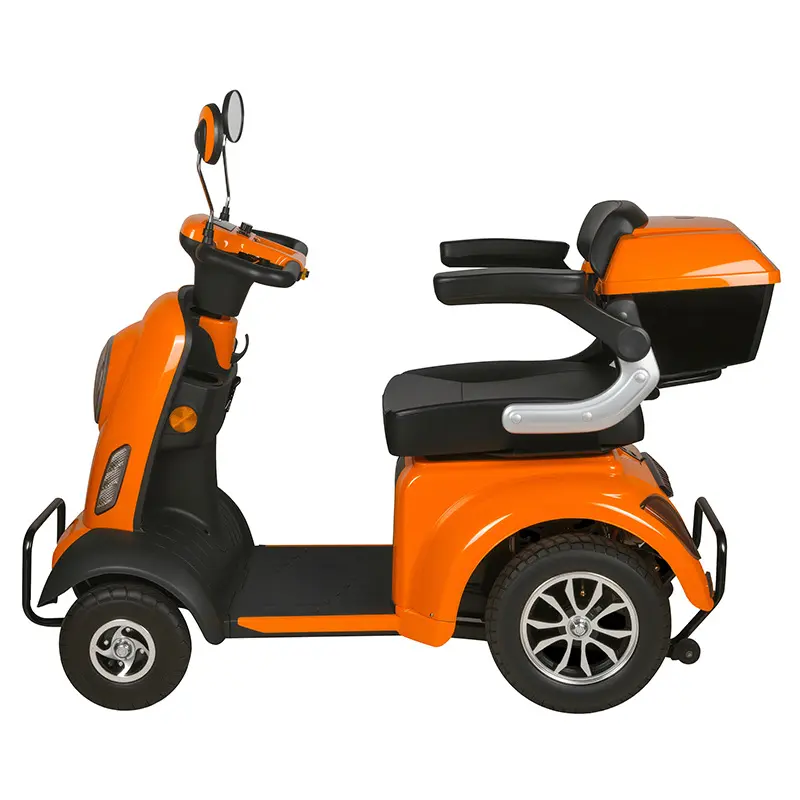
- Optional upgrade features for higher-margin inventory: shock absorption suspension, padded wide seat with armrests, front storage basket, reverse gear function
Frame Material
- Steel frames: High structural strength, lower manufacturing cost, suitable for heavy-duty trike lines
- Aluminum alloy frames: Lighter weight for portable folding scooters, anti-rust performance for coastal rainy regions, higher wholesale unit price
4 Main Mobility Scooter Series for Different Wholesale Business Models
- Portable Lite Mobility Scooters
Foldable, compact aluminum frame, lightweight lithium batteries. Perfect for airport, resort and city tourism rental businesses, plus retail stores targeting seniors who travel frequently. Easy container stacking cuts ocean shipping costs for large bulk orders.
- Standard Personal Mobility Trikes
The highest-volume wholesale category, 500W/600W motor options, balanced cost and performance. Designed for daily neighborhood shopping, doctor visits and short-distance errands, the core product for general retail distributors and assisted living facilities.
- Heavy-Duty Commercial Tricycles
Reinforced steel frames, high climbing power, extended battery range. Optimized for warehouse transit, community security patrol fleets and rural markets with uneven road surfaces. High durability reduces replacement frequency for institutional bulk buyers.
- Custom Specialized Mobility Units
Custom modified scooters with extra-wide seating, reinforced load-bearing frames or market-specific certification upgrades. Ordered in smaller bulk batches for disability support organizations and high-end healthcare facilities seeking differentiated product offerings.
Regional Compliance & Certification Rules Every Bulk Buyer Must Follow
European Union Market
North American Market
Southeast Asia, Middle East & Africa
Australia & New Zealand
Step-by-Step Bulk Sourcing Checklist to Avoid Costly Import Mistakes
- Define your target market region and collect full local certification requirements
- Outline target customer segments to select matching scooter product series
- Request physical sample units for 14–30 day real-world performance testing
- Verify all certification documents match the exact model specifications you plan to order
- Confirm written warranty terms covering motors, batteries and frame structures
- Request spare parts price lists and minimum bulk spare order thresholds
- Lock in fixed unit wholesale pricing, clarify shipping terms and production lead times
- Schedule pre-shipment third-party factory inspection to check assembly quality
- Prepare all customs clearance documentation aligned with import country rules
- Arrange spare parts co-shipment to cover initial post-delivery customer repairs
How to Evaluate a Reliable Mobility Scooter Manufacturer
- Industry tenure: Prioritize manufacturers with 15+ years of metal frame production and over 10 years dedicated to mobility scooter design and manufacturing
- Core technical advantages: In-house steel and aluminum frame processing teams plus independent electronic system R&D departments, rather than outsourced motor and battery assembly
- Bulk order capacity: Confirm monthly production output matching your maximum order volume, avoid suppliers with limited workshop space that cause delivery delays
- Global buyer references: Request contact details of existing wholesale distributors operating in your target regional market to verify after-sales support responsiveness
- Staff training systems: Factories with standardized worker training programs deliver consistent product quality across large batch orders, reducing defective unit rates
Cost Breakdown: Calculating True Total Landed Cost for Wholesale Orders
- Base factory wholesale unit price
- Customization fees (certification labeling, multi-language manuals, color modifications)
- Ocean/air freight and container loading fees
- Import duties, local sales tax and customs brokerage charges
- Third-party pre-shipment inspection costs
- Bulk spare parts inventory investment
- Local warehouse storage and last-mile delivery fees
- Potential warranty replacement reserve budget
Common Bulk Procurement Mistakes & How to Mitigate Risks
Mistake 1: Skipping sample testing before large orders
Fix: Mandate sample road testing across flat, sloped and wet surfaces; document braking performance, battery mileage and frame stability.
Mistake 2: Ignoring regional certification standards
Fix: Submit local regulatory documents to suppliers upfront and cross-check all certification serial numbers against ordered models.
Mistake 3: Failing to secure formal spare parts supply agreements
Fix: Sign written spare parts supply terms with guaranteed lead times and discounted bulk spare pricing.
Mistake 4: Over-ordering low-demand entry-level models without mixed inventory
Fix: Split bulk orders 60% standard daily trikes, 25% portable foldable lines, 15% heavy-duty commercial units for balanced sales velocity.
Post-Delivery Support & Spare Parts Planning for Long-Term Profit
- Initial co-shipped spare parts batch: Include brake pads, control panels, battery chargers and LED lights with every full container order to cover the first 6 months of customer repairs
- Quarterly small-batch spare restock orders: Schedule recurring minimal spare parts shipments to avoid stockouts of high-failure components like throttle controllers and shock absorbers
Final Takeaways for New & Experienced Wholesale Mobility Buyers
Post time: Jun-29-2026