

All-Terrain and Outdoor Mobility Scooters: Sourcing Specs for Rural and Recreational Use
For distributors serving rural communities, farm supply channels, hunting and fishing retailers, and outdoor recreation catalogs, the standard pavement mobility scooter is the wrong tool for the job. Buyers in these segments do not live on smooth sidewalks. They move across gravel driveways, packed dirt, grass fields, shallow ruts, and uneven pasture. They carry rifles, tackle boxes, feed bags, or camping gear. They expect a mobility aid that keeps working after a rain shower. This guide gives importers and B2B buyers a concrete sourcing framework for all-terrain and outdoor mobility scooters, focused on the specifications that actually determine field performance rather than showroom appearance.
Positioning: All-Terrain vs Standard Mobility Scooters
A standard indoor or pavement scooter is optimized for flat, hard, dry surfaces: shopping malls, clinic corridors, supermarket aisles, and city sidewalks. Its engineering priorities are tight turning radius, low step-through height, and lightweight portability. An all-terrain unit is a different product class with a different cost structure and a different failure mode profile. Confusing the two is the most common sourcing mistake we see among first-time outdoor buyers.
The all-terrain positioning targets three distinct buyer profiles. First, rural and farm residents who travel between a house, barn, workshop, and outbuildings on mixed gravel and grass. Second, hunters and anglers who need to reach remote tree stands, blinds, or lake banks where no path exists. Third, general outdoor recreation users who want a mobility aid that performs on unpaved ground during camping, gardening, or estate maintenance. None of these users cares about a 1.2-meter turning circle. All of them care about whether the scooter climbs a 12-degree ramp and survives a puddle.
Where the Two Classes Diverge
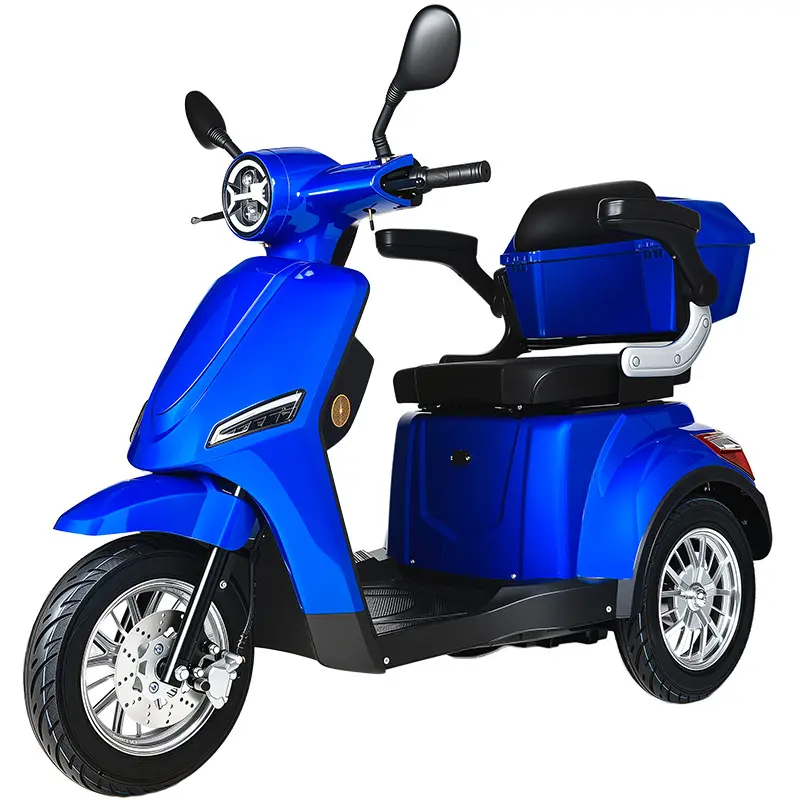
- Wheel and tire size: pavement units use 8 to 10 inch solid or small pneumatic wheels; outdoor units use 10 to 13 inch pneumatic tires with aggressive tread.
- Chassis height: pavement frames sit low for easy mounting; outdoor frames raise the deck for clearance.
- Suspension: pavement units often have none or only rear springs; outdoor units use front and rear shock absorbers.
- Sealing: pavement electronics are minimally protected; outdoor units require sealed controller and connector protection.
- Weight: outdoor units are heavier, which affects container loading and the freight cost per unit.
Key Outdoor Specifications
Ground Clearance
The single most defining number for off-pavement use is ground clearance. This is the vertical distance between the lowest fixed point of the chassis and the ground. On a paved scooter this may be only 50 to 70 millimeters. For outdoor use, specify a minimum of 100 millimeters, with 120 to 150 millimeters preferred for rutted farm tracks and rocky trails. Below 100 millimeters, the motor housing, battery tray, or front fork will scrape on the first exposed root or raised stone.
When comparing supplier quotes, ask for the measurement method. Some manufacturers quote clearance to the motor, others to the deck. Insist on the lowest fixed point, because that is what contacts the obstacle. A unit that claims 130 millimeters to the deck but only 80 millimeters to the motor is still a pavement scooter in practice.
Pneumatic Tires and Tread
For traction on loose surfaces, specify pneumatic knobby tires rather than solid or foam-filled wheels. Pneumatic tires absorb small impacts, improve grip on dirt, and reduce vibration through the frame. Knobby or deep-lug tread patterns channel mud and shed grass, while a near-smooth tread hydroplanes on wet grass.
Recommended outdoor tire sizes fall in the 4.10 to 5.00 inch width range on 10 to 13 inch rims. Front and rear should match or the handling becomes unpredictable on side slopes. Confirm the tread depth specification in millimeters and request a sample tire photo before committing to a production order. A common cost-cutting move is to fit a road-style tread to an otherwise outdoor frame; the result looks capable but slides on the first wet hill.
Suspension Systems
Suspension is what keeps the rider comfortable and the wheels in contact with the ground. For outdoor use, look for independent front suspension with coil-over or rubber bushings and a rear swingarm or twin-shock layout. Spring rate should be tunable or at least matched to the rated load. A scooter with no rear suspension will bounce the rear wheel off the ground on washboard tracks, losing drive and risking a tip on a turn.
Ask the supplier whether the shocks are sealed against dust and water. Open shock shafts seize quickly in muddy conditions. Sealed units cost more but survive a season of farm use. This is a specification worth paying for in the outdoor segment.
Motor Power and Battery Capacity Trade-offs
Climbing ability and range pull in opposite directions, and the battery is usually the constraint. A 24-volt 400-watt brushless hub or transaxle motor is adequate for flat rural lanes but struggles above 10 degrees of sustained grade, especially with a heavy rider and gear. For hilly property, step up to 24-volt 500 to 800-watt output or a 36-volt system in the 600 to 1000-watt range.
Battery capacity then sets the range. A 24V 20Ah lead-acid pack typically returns 15 to 20 kilometers of mixed outdoor use; a 24V 30Ah to 40Ah lithium pack returns 25 to 40 kilometers. More capacity means more weight and more cost, and on rough terrain the effective range drops because climbing and soft ground draw higher current. As a sourcing rule, derate the supplier’s flat-road range claim by 25 to 35 percent for realistic outdoor duty.
Match the motor controller’s continuous current rating to the motor. An undersized controller overheats on long climbs and goes into thermal cutoff, leaving the rider stranded mid-slope. Request the controller’s rated amperage and confirm it exceeds the motor’s peak draw by a safe margin.
Stability and Anti-Tip Architecture
Outdoor terrain introduces side slopes, off-camber ruts, and sudden drops that a clinic floor never presents. Stability comes from three interdependent factors: a long enough wheelbase, a low center of gravity, and effective anti-tip protection. A wheelbase below 800 millimeters feels tippy on grass; 900 to 1100 millimeters is the outdoor sweet spot for three-wheel designs, while four-wheel units can use a slightly shorter base because the wider track adds lateral stability.
Center of gravity is lowered by mounting the battery low in the chassis and keeping the seat height moderate. Seats that sit too high turn a side slope into a rollover risk. Anti-tip wheels at the rear should be substantial, not the tiny casters found on indoor models. For genuine outdoor use, specify anti-tip wheels of at least 75 millimeters diameter with enough ground offset to engage before the main frame contacts the slope.
Note the distinction from our stability-testing article: that piece covers test methodology and braking performance. Here the focus is component selection at the sourcing stage, before any unit reaches a test lab.
Weather Resistance and Waterproofing
Outdoor duty demands a sealed controller housing with an ingress protection rating appropriate to the environment. At minimum specify IP54 for the controller and IPX4 for the display; IP65 is preferable for units marketed as all-weather. The connector system is the weak point. Loose or unsealed harness connectors wick moisture, corrode, and cause intermittent faults that are nearly impossible for a dealer to diagnose in the field.
Require sealed Deutsch-style or equivalent weatherproof connectors on the throttle, brake, motor, and battery looms. Confirm the battery compartment has a gasket and drain weep holes so condensation does not pool around terminals. Cable entry points through the deck should use rubber grommets, not raw holes. These details separate a scooter that lasts a season outdoors from one that fails in the first month of rain.
Load Capacity Tiers and Gear Margin
Published capacity is the rider weight alone, but outdoor users carry gear. A hunter with a rifle, ammunition, and a day pack adds 12 to 20 kilograms. An angler with a tackle box and cooler adds similar weight. A farmer moving a feed bag adds 25 kilograms or more. Always include a load margin of at least 20 percent above expected rider-plus-gear weight when selecting a tier.
Typical outdoor tiers run 135 kilograms, 160 kilograms, and 200 kilograms maximum user weight. For a 90 kilogram rider plus 30 kilograms of gear, the 135 kilogram tier is already over its safe limit; the 160 kilogram tier is the correct choice. Overloading degrades climb performance, accelerates tire and suspension wear, and voids structural warranties. Build the margin into your product page copy so the end user self-selects the right tier.
Compliance and Claim Boundaries
Compliance for mobility aids varies by destination market, and claims must stay within what the actual applicable regulation supports. Electromagnetic compatibility and electrical safety requirements differ between the United States, the European Union, the United Kingdom, and other regions, and the correct standard depends on the intended market and product classification. Do not present a single certification as universal. EMC and electrical safety marks should be stated only for the markets where they have been genuinely obtained, and the specific regulation or standard should be named precisely.
For medical-device classifications, the rules differ by jurisdiction and change over time; confirm the current status with the responsible authority or a qualified compliance consultant, and treat uncertain points as subject to the latest official announcement. Keep all marketing restrained: describe the product as a mobility aid, avoid therapeutic or recovery claims, and reserve clinical language for licensed contexts. Fabricating or overstating a certification is a serious liability and a fast route to a marketplace suspension.
Tip: Never list a certification mark on a product or listing unless you hold the actual test report and the scope explicitly covers the model and destination market, because a single unsupported claim can trigger a recall and a platform ban across your entire catalog.
Shipping, Battery Transport and Quick-Release Design
Battery transport rules shape how you import and distribute outdoor scooters. Lithium packs are regulated as dangerous goods under the UN38.3 framework and relevant air and sea provisions; lead-acid packs have separate handling rules. Many buyers consolidate by shipping the scooter frame by sea and the batteries by a qualified dangerous-goods route, or by sourcing batteries locally to avoid cross-border battery freight entirely. Confirm the supplier’s UN38.3 test summary and the correct shipping description before booking container space.
For the frame itself, specify quick-release disassembly on the seat, battery, and sometimes the tiller or rear wheels. Outdoor units are bulky, and a design that breaks down into two or three manageable cartons improves both warehouse handling and last-mile delivery to a rural customer. Verify the disassembly requires only common tools and that no calibration is lost when the tiller is removed and refitted.
Procurement Decision Checklist
Use the following checklist when evaluating an outdoor mobility scooter supplier or model:
- Ground clearance measured to the lowest fixed point: 100 millimeters minimum, 120 plus preferred.
- Tire type: pneumatic knobby, 10 to 13 inch rim, matched front and rear, with documented tread depth.
- Suspension: front and rear, sealed shocks rated for the intended load.
- Motor: 500 to 1000 watts for hilly property; controller amperage exceeds motor peak draw.
- Battery: lithium preferred for weight and cycles; range derated 25 to 35 percent for terrain.
- Stability: wheelbase 900 millimeters plus, low battery mount, anti-tip wheels 75 millimeters plus.
- Weatherproofing: sealed controller IP54 minimum, weatherproof connectors, grommeted cable entry.
- Capacity: chosen tier exceeds rider plus gear by at least 20 percent.
- Compliance: only marks actually held are listed, scoped to model and market; uncertain items flagged as subject to latest announcement.
- Logistics: UN38.3 summary available, quick-release disassembly verified with common tools.
- Spares: suspension bushings, tires, and connectors stocked before the first container arrives.
Frequently Asked Questions
Can a standard pavement scooter be used on a farm?
Only on smooth, hard, dry lanes. The low ground clearance, small tires, and minimal sealing mean it will scrape, lose traction, and corrode quickly on real farm terrain. For anything beyond a graded driveway, an all-terrain unit is the correct specification.
Is lithium or lead-acid better for outdoor use?
Lithium is lighter, cycles longer, and performs better in cold, which matters for outdoor duty. Lead-acid is cheaper upfront and simpler to ship by some routes, but it is heavy and loses capacity in low temperatures. For active outdoor users, lithium is usually worth the premium.
What ground clearance do I actually need?
For grass and gravel, 100 millimeters is the floor. For rutted tracks, roots, and rocky ground, specify 120 to 150 millimeters. Measure to the lowest fixed point, not the deck.
How much range should I promise customers?
Take the supplier’s flat-road figure and reduce it by 25 to 35 percent for outdoor use, then state the lower number. Climbing, soft ground, and cold weather all cut range, and overpromising creates returns and complaints.
Do outdoor scooters need special certifications?
They need the same market-appropriate EMC and electrical safety compliance as any mobility aid, but no special off-road certification exists. Only list marks you actually hold, scoped to the model and destination, and confirm medical-device status with the relevant authority as requirements change.
Related Pages
- Mobility Scooter Wholesale: Complete Buyer’s Guide 2026
- CE Certification for Mobility Scooters: Complete Guide
- How to Get the Best Price on Mobility Scooters
- Mobility Scooter Factory Audit Guide
Ready to source all-terrain and outdoor mobility scooters built for rural and recreational channels with verified specs and compliant documentation?
Post time: Oct-12-2026