

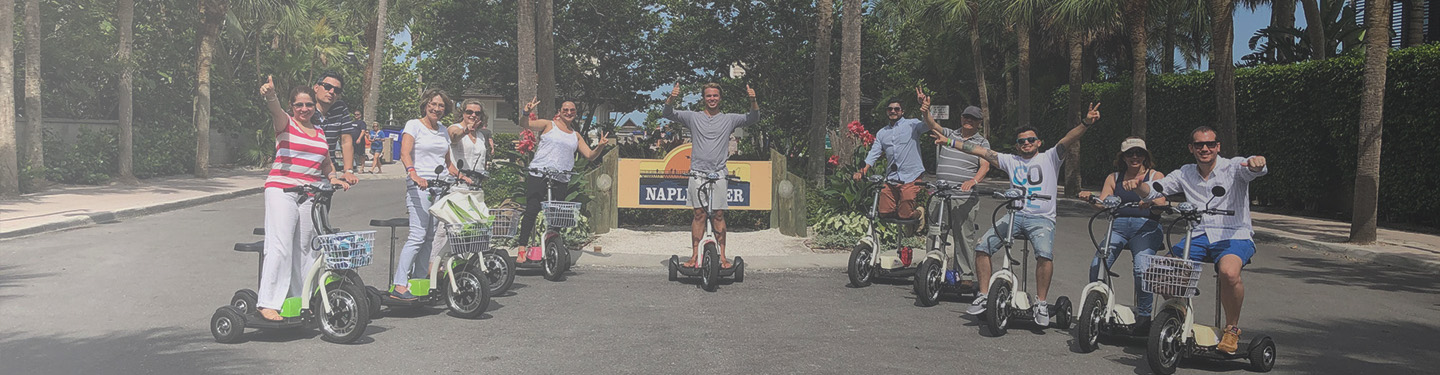
Wellsmove Electric Four-Wheeled Mobility Scooter Global Purchasing Guide
According to the United Nations’ “World Population Prospects 2025″ report, the global population aged 65 and over has exceeded 12%. The accelerating aging process, coupled with the popularization of green travel concepts, has made electric four-wheeled mobility scooters an increasingly important tool for improving travel quality. As a brand that has been deeply involved in the personal mobility field for more than ten years, Wellsmove leverages over 20 years of experience in metal structures and electronic systems technology to provide global users with electric four-wheeled mobility scooter solutions covering diverse scenarios. This article will create a professional global purchasing guide from five dimensions: demand positioning, core configuration, safety performance, scenario adaptation, and brand after-sales service.
I. Precisely Positioning Needs: Matching Travel Solutions for Different Groups
The first step in purchasing an electric four-wheeled mobility scooter is to clarify the user group and core needs. The differences in needs among different groups directly determine the direction of model selection.
1. Elderly Group: Comfort and Stability First, Ease of Operation Paramount
For elderly users, the core needs of a mobility scooter are ease of operation, high stability, and low energy consumption. Daily travel scenarios mostly involve short trips such as community shopping, park walks, and hospital visits. Therefore, priority should be given to models with lightweight bodies and flexible steering. It is recommended to consider models with one-button start, rotary gear shift, and reversing camera to reduce the operating threshold.
Wellsmove, based on a “people-oriented” design philosophy, optimizes the control system for the physical characteristics of elderly users, allowing older people to easily get started. Its 200 mobility scooters exported to Italy have gained local market recognition due to their suitability for the needs of the elderly.
2. People with Disabilities: Customized Adaptation and Effort-Saving Design
People with disabilities have a greater need for barrier-free adaptation and effort-saving operation in mobility scooters. Key considerations include the ease of getting on and off the vehicle, such as whether it is equipped with a side-tilting seat and ramp assistance function; at the same time, battery life and smooth power output are also crucial to avoid affecting the travel experience due to frequent charging or power interruptions.
Wellsmove’s product development team is deeply committed to the travel needs of people with special needs and can provide customized modification services, such as adding handrails and adjusting seat height, to create exclusive travel solutions for people with disabilities.
3. Commercial Scenarios: Durability and Load Capacity as Core Requirements
In commercial scenarios such as tourism rentals, security patrols, and warehouse logistics, mobility scooters need to possess high durability, large load capacity, and long battery life. Tourism rental models need to balance comfort and aesthetics to attract tourists; security patrol models require long range to meet all-day patrol needs; and warehouse logistics models need enhanced load capacity to adapt to cargo handling scenarios.
Wellsmove’s heavy-duty three-wheeled scooter series has been widely used in warehousing and patrol applications. Its technical advantages in steel and aluminum metal structures can be extended to four-wheeled mobility scooter products, ensuring high-intensity use in commercial scenarios.
4. Leisure Users: Balancing Lightweight Design and Fun
Young leisure groups prioritize aesthetics and maneuverability when choosing mobility scooters, mainly for short-distance urban commuting, campus transportation, and suburban camping. It is recommended to choose models with a compact body, stylish colors, and certain climbing capabilities to handle complex road conditions in suburban areas.
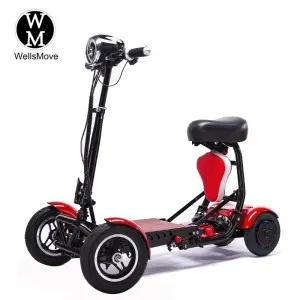
II. Focusing on Core Configurations: Key Factors Determining Mobility Scooter Performance
Core configurations directly affect the power, range, and durability of mobility scooters, and are of paramount importance during procurement. Based on global industry standards and Wellsmove’s technical advantages, the following four points should be given special attention:
1. Motor System: Power Matching the Scenario, Balancing Power and Energy Consumption
The motor is the “heart” of the mobility scooter, and the power selection needs to be precisely matched to the usage scenario. For daily commuting, a 1000-1500W permanent magnet motor is sufficient, offering low energy consumption and smooth power; if complex terrain such as slopes and sandy areas needs to be handled, a 2500-4000W high-power motor is recommended, combined with a four-wheel drive design to improve vehicle passability.
Wellsmove has extensive experience in motor technology. Its 2022 three-wheeled mobility scooter is equipped with a 600W motor, capable of climbing a 30-degree slope. This technical advantage has been applied to the development of four-wheeled mobility scooters, ensuring stable output in complex terrain. At the same time, the brand’s FOC vector controller effectively reduces energy consumption and improves the smoothness of torque output. 2. Battery Configuration: Lithium-ion Batteries Preferred, Focusing on Range and Safety
The battery is the core component that determines the range of a mobility scooter. Currently, lithium-ion batteries are the mainstream in the global market, offering significantly higher energy density and cycle life than traditional lead-acid batteries. According to international standards, a qualified electric four-wheeled mobility scooter’s lithium-ion battery should have an energy density of ≥120 WH/KG and a range of ≥100 kilometers to meet daily travel needs.
Voltage and capacity selection should be combined with power requirements:
48V battery: paired with a 500-1000W motor, suitable for short-distance travel, with a range of approximately 50-80 kilometers;
60V/72V battery: paired with a 1500-4000W motor, with a range of 100-130 kilometers, suitable for long-distance travel or commercial applications.
Wellsmove’s mobility scooter products support 48V 12A/20A battery configurations, allowing users to upgrade as needed. They are also equipped with an intelligent battery management system (BMS) to monitor battery status in real time, extend battery life, and ensure charging safety.
3. Frame Structure: Steel and Aluminum Materials Preferred, Balancing Strength and Lightweight Design
The frame is the “skeleton” of the mobility scooter, directly determining the vehicle’s durability and safety. Wellsmove has over 20 years of experience in steel and aluminum metal structure research and development. Its frames use an integrated molding process, which is more impact-resistant than traditional welded frames and can withstand the bumps and impacts of complex road conditions without deformation.
At the same time, the steel and aluminum materials achieve a balance between strength and lightweight design, ensuring the vehicle’s load-bearing capacity while reducing body weight and improving range performance. This technological advantage is one of Wellsmove’s core competitive advantages in the global electric mobility scooter market. 4. Control System: Humanized Design for Enhanced Driving Experience
A high-quality control system significantly improves driving comfort. The following details should be considered:
Steering System: Power steering reduces steering effort, especially suitable for elderly users;
Suspension System: Car-grade suspension effectively filters road bumps, improving ride comfort;
Instrument Panel: The LCD instrument panel should clearly display speed, battery level, range, and other information, allowing users to monitor the vehicle status in real time.
III. Safety First: Uncompromising Safety Performance Indicators
Electric four-wheeled mobility scooters are often used by vulnerable groups, making safety performance a crucial factor in purchasing decisions. Consideration should be given to structural safety, braking system, and auxiliary features.
1. Structural Safety: Four-Wheel Design for Greater Stability on Complex Road Conditions
Compared to three-wheeled mobility scooters, the four-wheeled design has a larger contact area with the ground, providing greater stability and effectively reducing the risk of tipping over. The minimum ground clearance should also be considered; a model with a ground clearance of ≥145mm is recommended to improve passability on gravel and wet roads.
Wellsmove’s frame structure has undergone rigorous impact testing, and combined with the stable four-wheel layout, it ensures user safety on slopes and slippery surfaces.
2. Braking System: Four-Wheel Disc Brakes are the Preferred Choice for Sensitive and Reliable Braking
The braking system is the core safety guarantee. Four-wheel disc brakes offer superior braking performance compared to drum brakes, with faster heat dissipation and sensitive response, allowing for quick stopping in emergency situations. In addition, electronic parking brakes and hill-start assist functions further enhance safety, preventing the vehicle from rolling back on slopes.
3. Auxiliary Features: Comprehensive Protection for Travel Safety
Complete auxiliary features provide comprehensive protection for travel safety. It is recommended to prioritize models equipped with the following functions:
Lighting System: LED headlights, daytime running lights, and turn signals should be included to improve visibility during nighttime driving;
Anti-Slip Tires: Off-road tire tread design enhances grip and is suitable for wet and muddy surfaces;
Electronic Stability Program (ESP): Maintains vehicle stability during sharp turns and emergency braking, reducing the risk of skidding.
IV. Scene Adaptability: Making Mobility Scooters Suitable for Diverse Usage Needs
A high-quality electric four-wheeled mobility scooter needs to adapt to different usage scenarios, enabling “multiple uses with one vehicle.” Based on the usage needs of global users, the following four scenarios can be considered:
1. Urban Daily Scenarios: Flexible maneuvering and convenient transportation
Urban road scenarios are complex, requiring vehicles to be compact, flexible, and easy to operate. The vehicle length is recommended to be kept within 3 meters for easy maneuvering in narrow streets and underground parking lots. At the same time, it must comply with local traffic regulations, such as the speed limit of ≤40km/h for low-speed mobility scooters in some countries.
2. Outdoor Leisure Scenarios: Climbing slopes and overcoming obstacles, adapting to complex terrain
Outdoor scenarios such as camping and sightseeing require high climbing ability and off-road capability. It is recommended to choose models equipped with high-power motors and four-wheel drive systems, coupled with a differential lock design, allowing for easy escape even if one tire slips. Wellsmove’s 30-degree climbing technology ensures stable driving on slopes in suburban areas.
3. Commercial Operation Scenarios: High durability and low maintenance costs
Commercial scenarios such as tourism rentals and security patrols require vehicles with low failure rates and low maintenance costs. Wellsmove’s steel-aluminum frame and high-quality electronic system effectively reduce vehicle failure rates, while the brand’s supply of original parts shortens repair cycles and reduces operating costs.
4. Special Environment Scenarios: Cold and heat resistance, adapting to extreme climates
In high-latitude cold regions or tropical high-temperature regions, the vehicle’s environmental adaptability needs to be considered. The lithium battery needs to have low-temperature starting capability, able to start normally in a -20℃ environment; at the same time, the vehicle’s waterproof rating needs to reach the IP67 standard to cope with rainy seasons or flooded roads.
V. Avoiding Common Purchasing Mistakes: These Pitfalls Must Be Avoided
When purchasing electric four-wheeled mobility scooters, you need to avoid the following common mistakes:
Focusing solely on price and neglecting specifications: Low-priced models often use inferior batteries and motors, resulting in short range and high failure rates, leading to higher long-term costs;
Blindly pursuing high power: High-power motors consume more energy, and if you only use the scooter for short-distance commuting, it will result in wasted resources;
Ignoring local regulations: Different countries have different speed limits and registration requirements for mobility scooters. Before purchasing, you need to understand local policies to avoid being unable to use the scooter on public roads.
Post time: Jan-21-2026