

European Distributors Conduct Sample Testing of Electric Tricycles
In Europe, with an aging population and the promotion of green travel policies, electric tricycles are becoming an essential item for short-distance travel for the elderly and those with mobility impairments. As a distributor, you may have already targeted this blue ocean market, but sample testing remains a crucial step before bulk purchases. It not only determines whether the product can pass EU regulations but also directly impacts subsequent market reputation and user trust. Today, using the Wellsmove electric tricycle as an example, we’ll discuss how European distributors can mitigate risks and efficiently penetrate the local market through scientific sample testing.
Why must European distributors prioritize sample testing of electric tricycles?
Europe has one of the strictest regulations for mobility devices globally: electric tricycles that haven’t passed compliance certification will be directly seized by EU customs. Even if they enter the market, they cannot be registered and will ultimately face recall risks. More importantly, European consumers (especially the elderly) prioritize “safety” far more than price; an authoritative test report is often the core basis for their product selection.
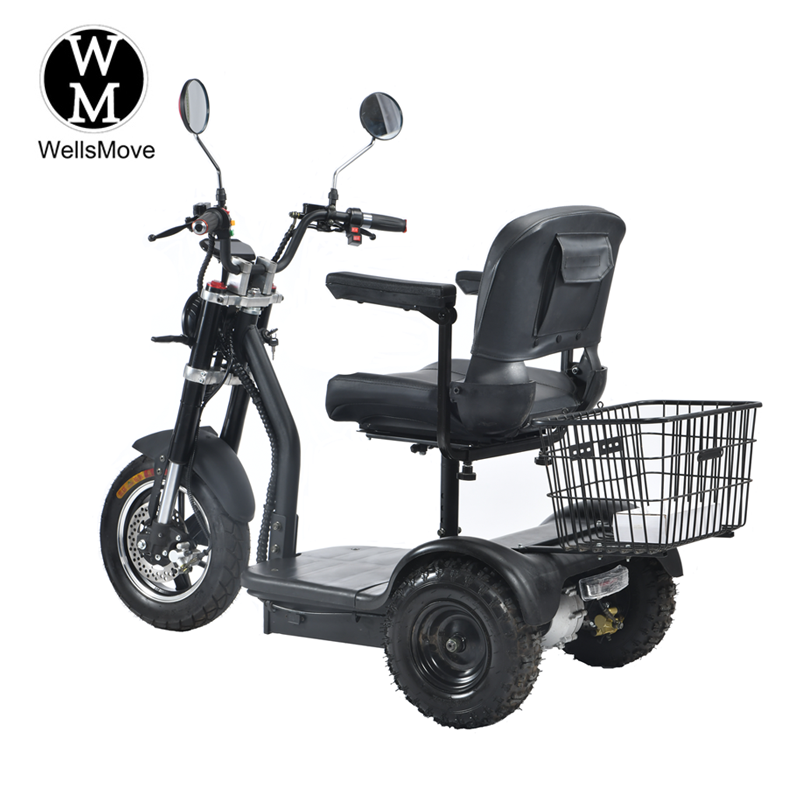
Wellsmove, a brand focused on electric mobility scooters for 13 years (focusing on personal mobile devices since 2010), positions its products as “safe and convenient,” specifically designed for the elderly and disabled in Europe. This means its sample testing needs to more accurately align with European market regulations and user needs, rather than simply meeting basic standards.
Three Core Dimensions of Sample Testing for European Distributors (with Wellsmove Testing Examples)
For electric tricycles, sample testing for European distributors needs to revolve around three dimensions: “compliance certification,” “core performance,” and “safety and durability.” Each dimension must closely adhere to EU standards and local usage scenarios.
1. Compliance Certification Testing: Obtaining EU “Entry Ticket”
To legally sell products in Europe, EEC certification (e-mark certification) and CE certification are two major “hard hurdles.” Sample testing must prioritize covering the core items of these two certifications:
EEC Certification Testing: According to the EU’s EC Directive, samples must pass seven key tests, including range, energy consumption, electrical safety, and maximum speed. Taking the Wellsmove electric tricycle as an example, its sample testing focuses on verifying the following:
Electrical safety: Insulation resistance must be ≥100MΩ (far exceeding the European standard’s minimum requirement of 50MΩ) to prevent electric shock for elderly users;
Maximum speed: Controlled at 35km/h (complies with EU speed limits for “low-speed mobility scooters” to avoid accidents caused by excessive speed);
Anti-theft performance: The battery compartment must pass an “anti-pry test,” simulating common theft scenarios in European cities to ensure device security.
CE certification testing: Must be based on three core standards—EN 15194:2009 (Safety of electric mobility scooters), EN ISO 4210:2014 (Safety of off-road vehicles), and EN 60335-1:2012 (Safety of electrical systems). Wellsmove tests samples for aspects such as “frame weld strength” and “charging system overload protection.” For example, under a static load of 500kg (equivalent to the weight of two adult users plus luggage), the frame’s elastic deformation must be ≤2mm to ensure it won’t bend over long-term use.
Why is this important? Without any certification, the product cannot clear EU customs; certified samples can quickly obtain market access permission from local regulatory authorities, saving time for subsequent bulk purchases.
2. Core Performance Testing: Matching European User and Road Condition Needs
The core of European distributor procurement is whether the product can meet the daily needs of the target users. Therefore, the performance testing of the samples must closely align with the travel scenarios of the elderly and European road conditions:
Power and Range: The Wellsmove sample is equipped with a 600W motor and a 48V 12A/20A battery. Testing will simulate “short-distance urban riding” (including flat roads and gentle slopes) in the laboratory:
Climbing Ability: Verifying whether the motor outputs stably and without hesitation when climbing a 30-degree slope (suitable for hilly European cities such as Rome and Lisbon);
Range Performance: The 48V 20A battery sample must achieve a range of over 35km (meeting the needs of elderly users for daily shopping, medical visits, etc., without frequent charging). Braking and Handling: Elderly users have slower reaction times, requiring more stringent braking system testing: Dry and Wet Road Testing: Tested at an initial speed of 20km/h (a common speed for European mobility scooters), braking distance on dry roads must be ≤4 meters, and on wet roads ≤6 meters (Wellsmove samples, through optimized brake disc material, can control the wet braking distance to 5.2 meters); Steering Flexibility: Testing steering torque (≤5Nm) to ensure effortless one-handed operation for elderly users without any “jerkiness”.
Dealer Note: Performance test data must match local user needs – for example, Nordic dealers can additionally request low-temperature range testing (battery capacity retention at -10℃) to avoid significant reduction in range during winter.
3. Safety and Durability Testing: Coping with the Complex European Environment
European weather is unpredictable (rainy and windy), and elderly users use the vehicle frequently; the “durability” of the sample directly impacts after-sales costs. Wellsmove samples undergo focused testing on these details:
Frame and Structure: As a brand with over 20 years of experience in metal construction, Wellsmove frames utilize high-strength steel. Testing involves applying a 50kN axial load using a hydraulic universal testing machine to verify weld cracking (permanent deformation ≤0.1mm) to prevent frame deformation after long-term use.
Waterproofing and Protection: The electrical system must pass an IPX5 waterproof rating (simulated continuous rain for 30 minutes in a laboratory), with no water ingress into the battery compartment or charger interface – crucial for the rainy Western and Northern European markets.
Lighting System: Headlight illumination must reach 1500 lux (compliant with EN standards), and brake light response time ≤0.3 seconds to ensure timely visibility to other vehicles during nighttime or cloudy riding, reducing the risk of collisions.
3 Key Actions for Dealers to Efficiently Complete Sample Testing
Knowing “what to test,” how can the testing process be streamlined and results more reliable? These three steps are crucial:
1. Choose an EU-recognized “authoritative laboratory”
To avoid invalid test reports due to insufficient laboratory qualifications: Prioritize laboratories that directly connect with the EU Ministry of Transport (such as Wellsmove’s partners TÜV in Germany and KEMA in the Netherlands). Reports from these laboratories can be directly used for EEC certification audits without secondary verification, shortening the process by 1-2 weeks.
2. Request “complete technical support” from the brand
Reputable brands will assist dealers in simplifying the testing process: Wellsmove can provide complete technical documentation for samples (such as motor parameter sheets, frame material certificates, and electrical schematics), avoiding repeated document supplementation due to “missing information.” If individual items fail to meet standards during testing (such as slightly low headlight illumination), the brand can also provide technical adjustment solutions (such as replacing LED bulbs), eliminating the need for resubmission of samples. 3. Building Market Trust Through Testing Reports
After passing testing, don’t let the report just sit in a filing cabinet: print key data (such as “EEC certified” or “braking distance 4 meters”) on product manuals, offline store posters, and even hold “sample experience events” through local senior citizen associations to showcase the testing report on-site. European consumers have a very high level of acceptance of “data transparency,” which can quickly increase the product’s market acceptance.
Case Study: Wellsmove’s Hungarian Distributor’s “Testing + Market Entry” Path
Previously, Wellsmove’s Hungarian distributor sent samples to an EU-accredited laboratory in Budapest at the beginning of the cooperation, focusing on testing three dimensions:
Compliance: EEC certification’s “anti-theft system” test (the sample passed dual verification via password unlocking and GPS positioning, meeting the requirements of the Hungarian transportation department);
Performance: 30-degree hill climb test (motor output power remained stable at 580W without overload);
Durability: Frame fatigue test (simulating 1000 bumpy road conditions, with no parts loosening).
With this qualified test report, the dealer completed the local market entry approval in just one month and subsequently secured a trial order for 200 vehicles. After its launch, many elderly users reported that the brakes were very stable and that they did not have to worry about electric leakage when riding in the rain. The repurchase rate reached 35% in the first month—this is precisely the “safety foundation” laid by the sample testing for the market.
Post time: Jan-30-2026