

Electric Tricycle Scooter Range Test for Seniors
With the accelerating global aging process, the United Nations’ “World Population Prospects 2025″ report shows that the proportion of people aged 65 and over has exceeded a critical threshold. “Safe and effortless short-distance travel” has become a core need for seniors in Europe, North America, and other regions. As a brand focused on personal mobility, Wellsmove’s electric tricycle scooters for seniors, with their “safety-first” design philosophy, have entered the testing and market launch phase with distributors in Europe and North America. This test focuses on their main models, simulating the daily usage scenarios of seniors overseas, and using real data to answer the core question: “How far can it travel on a single charge?”
I. Test Basis: Vehicle Models and Scenario Settings
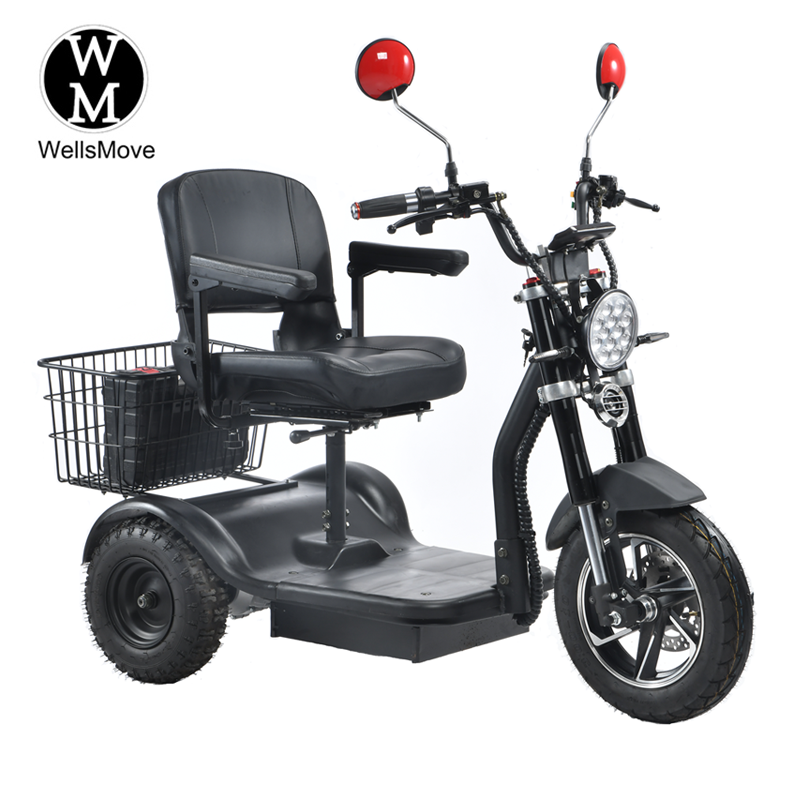
This test selected two core Wellsmove electric scooter models for seniors, both complying with overseas low-speed mobility vehicle safety standards (maximum speed ≤ 35km/h). The specific configurations and scenarios are as follows:
Test Model 1: Classic Model (500W motor + 48V12A lead-acid battery) – Designed for lightweight use, suitable for short-distance travel within communities for elderly people living alone.
Test Model 2: Long-Range Model (600W motor + 48V20A lithium battery) – Supports medium-distance scenarios such as visiting relatives in suburban areas and shopping at supermarkets.
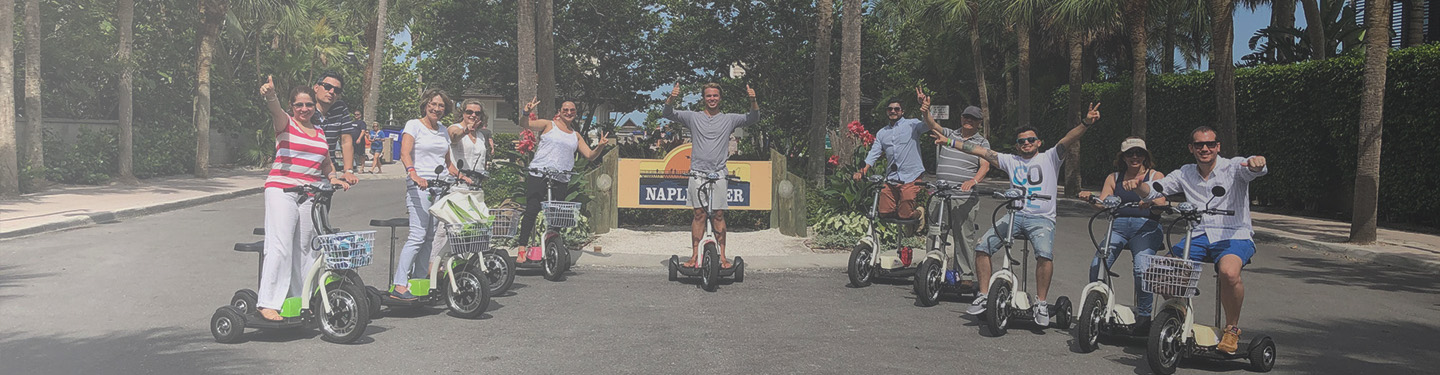
Simulated Scenarios: Covering high-frequency travel scenarios for seniors overseas, including “flat community roads (such as roads in American retirement communities),” “gentle slopes in suburban areas (around European towns),” and “low-temperature environments (winter in the northeastern United States),” and incorporating realistic load conditions such as “single rider (approximately 60kg)” and “carrying shopping bags (approximately 5kg).” II. Core Test Data: Range Performance in Different Scenarios
1. Basic Scenario: Range on Flat Roads (25℃ ambient temperature, no wind or rain)
This is the most common scenario for seniors overseas (e.g., strolling around the neighborhood, picking up prescriptions from nearby pharmacies). We tested using a “constant speed of 20km/h” (consistent with elderly driving habits):
Classic model (48V12A): Range of 42km under no-load conditions; with one person (60kg) + small shopping bag (5kg), the range drops to 38km, meeting the need for “3km round trip daily, charging once a week”;
Long-range model (48V20A): Range of 75km under no-load conditions; with a person and cargo (same conditions as above), the range is 68km, supporting “twice-weekly supermarket trips of 15km round trip each time,” without frequent charging.
2. Complex Scenarios: Range Reduction on Gentle Slopes and in Low Temperatures
Many residential areas overseas (such as hilly towns in Europe and suburbs in North America) have gentle slopes, and low winter temperatures significantly affect battery performance. These two factors are “key challenges” for range:
Gentle slope scenario (slope ≤15°, simulating a community entrance ramp): The classic model’s range decreases by approximately 18% when climbing slopes, dropping from 38km to 31km; the long-range model, due to its increased motor power (600W), has a range reduction of only 12%, maintaining 59km of range from the original 68km, easily handling uphill starts;
Low-temperature scenario (5℃/-5℃, simulating North American winter): Using the range at 25℃ ambient temperature as a baseline, the range of both models decreases by 10%-12% at 5℃, and the decrease expands to 25%-28% at -5℃. For example, the long-range model’s range drops from 68km to 50km at -5℃ with a passenger, but it can still meet the needs of “short trips for 3 days” (users are advised to park the vehicle in a garage during winter to reduce battery loss due to low temperatures). 3. Extreme Testing: Full Load and Continuous Driving Stability
Considering that some seniors may need to carry more items (such as holiday shopping or assisting neighbors with transporting small items), we included a “full load test” (total load ≤ 100kg, including personnel + items):
With the classic model under full load, the range further decreased to 27km due to the smaller battery capacity, suitable for “short distances and light loads”;
With the long-range model under full load, the range remained at 48km, and the battery voltage remained stable after 1.5 hours of continuous driving (no sudden drops). This is thanks to Wellsmove’s core advantages – the steel-aluminum metal structure body reduces driving resistance, and the professional electronic system optimizes motor energy consumption distribution, avoiding the problem of “sudden increase in power consumption under heavy load.”
III. Wellsmove’s “Hidden Advantages” in Range Optimization
During testing, we found that in addition to the battery and motor hardware configuration, Wellsmove’s design details also “indirectly improve practical range,” which is especially important for the elderly:
Low-speed stable design: The vehicle’s maximum speed is 35km/h, but the default recommended “20-25km/h” economic speed is used. At this speed, the motor energy consumption ratio is the lowest, resulting in 8%-10% more mileage than users who frequently accelerate and decelerate;
Lightweight and safe body design: Using a steel-aluminum hybrid frame, it is 15% lighter than an all-steel body, reducing motor load, but the load capacity still reaches 150kg, balancing “range” and “safety for carrying people and goods”;
Battery protection mechanism: The vehicle comes with a “low battery reminder” (automatic reminder when 20% battery remains), preventing excessive battery discharge – tests show that maintaining charging within the “20%-80% battery range” extends battery cycle life by 30%, indirectly ensuring that the “range does not significantly decrease within 1-2 years.” IV. Battery Life Optimization Tips for Overseas Seniors
Based on test data and overseas usage environments, we have compiled three “battery life optimization tips” for Wellsmove users:
Charging Habits: You don’t need to fully charge every time; charging to 80% after daily use is sufficient (fully charge only before long trips), avoiding prolonged storage with a fully charged battery;
Route Selection: Try to avoid continuous steep slopes (slopes > 20°), and prioritize “accessible roads” within the community to reduce high motor load;
Daily Checks: Check tire pressure weekly (insufficient tire pressure increases rolling resistance, reducing battery life by 5%-8%), and adjust the braking system so that braking is responsive with light pressure, avoiding extra power consumption due to overly tight brakes.
Post time: Feb-06-2026