

Bulk Procurement of Electric Tricycles for the Elderly: A Comprehensive Quality Control Guide
The global aging process is accelerating. The United Nations’ “World Population Prospects 2025″ report shows that the proportion of the global population aged 65 and over has exceeded 12%. Electric tricycles for the elderly, as a core product for enhancing the independence of elderly people’s mobility and improving their quality of life, are experiencing continuously increasing demand in the international market. For overseas buyers, quality control in bulk procurement directly impacts end-user safety, market compliance, and long-term brand development. Wellsmove, with over 20 years of experience in the electric mobility field, has leveraged its professional expertise in metal structures and electronic systems, along with its global market service experience, to summarize the key points of quality control throughout the entire process of bulk procurement of electric tricycles for the elderly, providing practical and actionable guidance for buyers.
I. Pre-Procurement: Qualification Verification and Design Validation, Laying a Solid Foundation for Quality
Quality control in bulk procurement requires mitigating risks from the source, focusing on two key dimensions: supplier qualifications and product design.
(I) International Standard Verification of Supplier Qualifications
Industry Experience and Production Capabilities: Prioritize suppliers with long-term, stable production experience. Wellsmove has been involved in vehicle metal frame manufacturing since 2003 and has focused on the research and development and production of electric mobility products since 2010. Over 20 years of technological accumulation have given it unique advantages in core areas such as steel and aluminum structure processing and electronic system integration, ensuring the stability and consistency of mass production.
International Compliance Certifications: Products must pass core certifications in the target market, such as European CE certification, US FDA certification, and ISO9001 quality system certification, to ensure compliance with local safety, environmental, and industry standards. Compliance certification is not only a prerequisite for market entry but also a fundamental guarantee of product quality.
Market Validation Cases: Verify the supplier’s past international cooperation experience, especially the delivery and feedback of bulk orders. Wellsmove provided a trial order of 200 electric tricycles to a Hungarian distributor. The products were validated in the European market and, thanks to their stable performance, led to subsequent long-term cooperation. Such real-world cases are direct evidence of the supplier’s quality capabilities. (II) Elderly-Friendly Quality Considerations in Product Design
The physiological characteristics and travel scenarios of elderly users dictate that product design must be centered on “safety, convenience, and durability”:
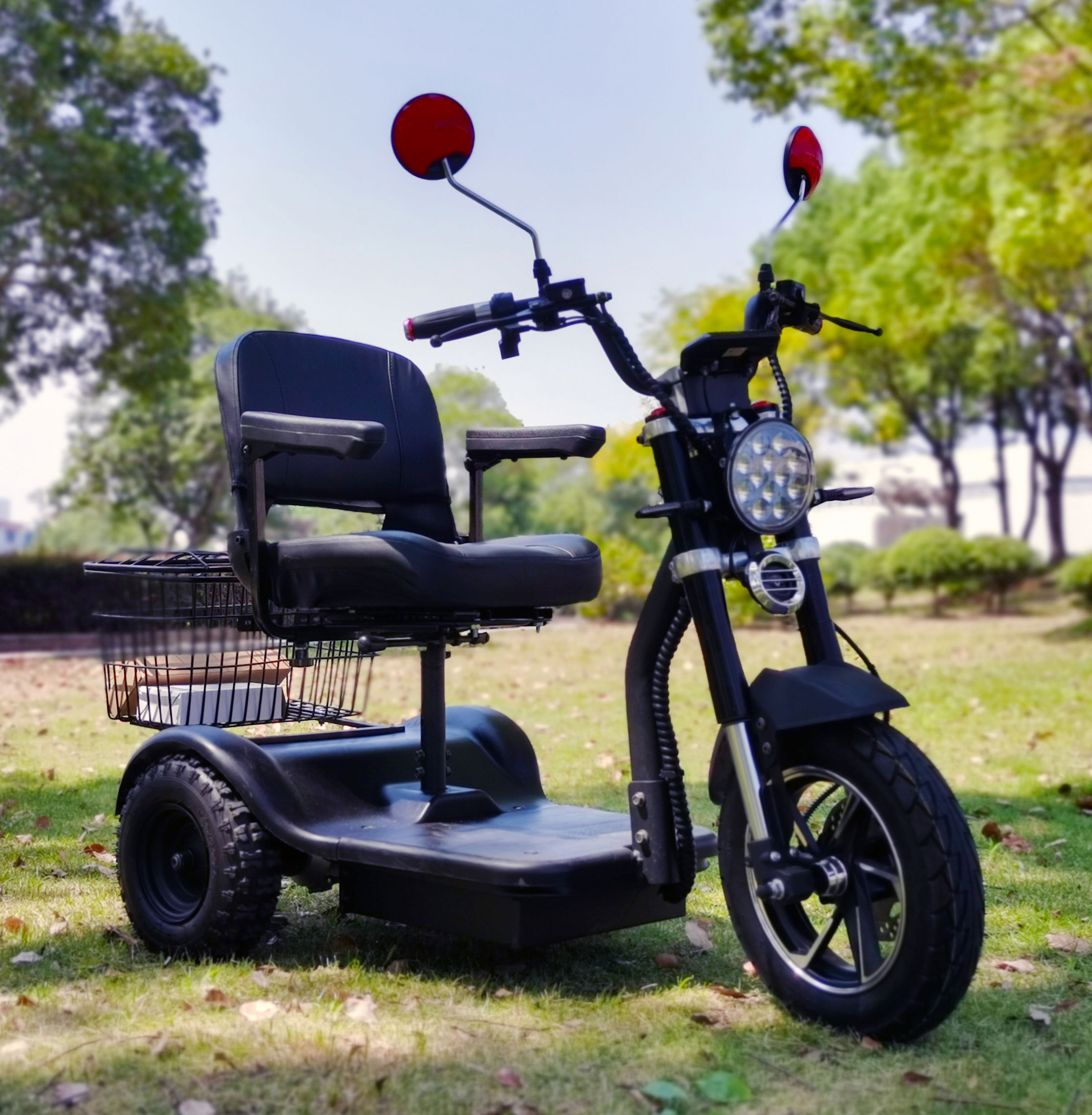
Safety-oriented design: Adopting a three-wheeled stable structure, lowering the center of gravity, and equipping with anti-tipping devices; the braking system needs to be adapted to the reaction speed of the elderly, ensuring sensitive and smooth braking to avoid safety risks caused by sudden braking; anti-collision buffer structures are set up in key parts of the vehicle body to reduce injuries from accidental collisions.
Convenient operation design: The control panel needs to be simple and intuitive, with clear and easy-to-read labels, avoiding complex buttons; the battery life needs to match the daily short-distance travel needs of elderly users. Wellsmove products are equipped with 48V 12A/20A high-capacity batteries, which can meet the range requirements for daily shopping, medical visits, and leisure activities, reducing the frequency of charging.
Durability adaptation design: For the long-term use needs of elderly users, the frame uses high-strength steel and aluminum materials with anti-rust and anti-corrosion properties; the motor power needs to balance power and energy efficiency, with 500W/600W motors easily handling 30-degree slopes, adapting to different road conditions, while ensuring low-noise operation.
II. Production Process: Full-Chain Control, Controlling the Quality of Every Process
The mass production stage is a critical link for quality fluctuations, requiring refined control from raw materials to production processes.
(I) Strict Screening of Raw Materials and Components
Core structural materials: As the foundation of product safety, the steel and aluminum materials for the frame must pass strength, toughness, and corrosion resistance tests. Wellsmove, with its professional metal structure technology team, conducts full inspection of raw materials upon arrival to ensure compliance with international metal material standards, guaranteeing the load-bearing capacity and durability of the vehicle body from the source.
Key component review: Core components such as batteries, motors, and controllers must be selected from suppliers with international certifications, requiring third-party test reports. Batteries must pass safety performance tests to eliminate leakage and overheating risks; motors must meet low noise and high stability requirements to ensure long-term trouble-free operation; controllers must achieve precise speed control, adapting to the operating habits of elderly users. Auxiliary Material Control: The seats are made of anti-slip, breathable, and wear-resistant environmentally friendly materials to ensure comfort during long periods of use; the tires are made of high-quality, pressure-resistant, and anti-slip rubber to enhance grip on different road surfaces and reduce bumps.
(II) Standardized Management of Production Processes and Operations
Standardized Production Process: Clear SOPs (Standard Operating Procedures) are established. For key processes such as frame welding and electronic system assembly, a combination of automated equipment and manual verification is used to reduce human error. Through years of process optimization, Wellsmove has formed a mature production process system to ensure the consistency of each batch of products.
Employee Skills and Quality Awareness Training: Adhering to the philosophy of “high-quality employees create high-quality products,” Wellsmove has established a regular training mechanism, conducting periodic skills improvement and quality awareness training, requiring employees to master the quality standards of each process, clarify inspection points, and ensure that every process meets quality requirements.
In-Process Inspection and Real-Time Correction: Multiple quality inspection points are set up throughout the production process to conduct real-time testing of welding accuracy, component assembly fit, and electronic system connection stability. Defective products are immediately reworked to prevent problems from flowing to the next process, ensuring the overall quality of mass production.
III. Factory Inspection: A combination of sampling and full inspection to prevent defective products from leaving the factory
After mass production is completed, a scientific testing system is used to ensure that each batch of products meets quality standards, primarily using a dual mode of “sampling inspection + full inspection verification.” (I) Sampling Inspection: Covering Core Performance and Verifying Batch Stability
Following international sampling standards, samples are randomly selected from each batch of products for comprehensive performance testing:
Core performance testing: Speed test (controlled within 35km/h, complying with safety speed limits for elderly mobility scooters), actual road range test (ensuring consistency with the stated range), and climbing ability test (verifying passability on 30-degree steep slopes, adapting to different terrains);
Safety performance testing: Braking distance test (must meet standards under both unloaded and fully loaded conditions), anti-tipping test (stability on inclined surfaces), and overload test (verifying the vehicle’s load-bearing limit);
Environmental adaptability testing: Simulating high and low temperature environments (-10℃~40℃) to test product operational stability, and rain test to verify waterproof rating, ensuring the product adapts to different regional climate conditions.
(II) Full Inspection and Verification: Focusing on Detail Quality and Ensuring Individual Product Qualification
After the sampling inspection is passed, each product undergoes a full inspection, focusing on detail quality:
Appearance quality: Checking for scratches, paint chips, and deformation on the vehicle body, ensuring secure installation of components, and clear and complete markings (including product model, certification marks, safety warnings, operating instructions, etc.);
Functional integrity: Power-on testing of all operating functions, including speed control, brakes, lights, horn, seat adjustment, etc., ensuring no jamming or malfunction;
Assembly precision: Checking for accurate wheel alignment, smooth steering without abnormal noise, no looseness in connecting parts, and secure wiring of the electronic system to prevent malfunctions during use.
IV. After-Sales Guarantee: Compliance and Traceability in Parallel, Reducing Procurement Risks
High-quality control is not limited to product ex-factory; comprehensive after-sales support and compliance guarantees are important complements to bulk purchasing.
(I) Completeness of Compliance Documents and Certifications
The supplier must provide a complete set of compliance documents required by the target market, including product certification certificates, third-party quality inspection reports, multi-language product manuals, warranty terms, etc. The manual should clearly indicate safety precautions, daily maintenance methods, common troubleshooting, etc., adapted to the language requirements of the buyer’s target market, reducing the risk of use for end-users. (II) Quality Traceability and After-Sales Support
Full-process traceability system: Each batch of products is assigned a unique batch number, linked to information such as raw material batches, production personnel, and testing records. In the event of a quality issue, the source of the problem can be quickly identified, enabling precise recall and corrective actions, thus reducing the risk of mass quality problems;
Long-term after-sales guarantee: A reasonable quality guarantee system is established, with a clearly defined warranty period; spare parts for easily damaged components are provided to ensure that purchasers can provide timely repair services to end-users; remote technical support is also provided to assist in resolving technical problems during product use.
Post time: Feb-04-2026