

2026 Global Trends in Senior Citizen Tricycles
Wellsmove Analyzes New Directions in Mobility
According to the UN’s “World Population Prospects 2025″ report, the global population aged 65 and over has exceeded 12%, and the aging process is driving the demand for “age-friendly mobility” from “optional” to “essential.” In the short-distance travel sector, senior citizen tricycles, with their advantages of being more stable than two-wheeled vehicles and more flexible than four-wheeled low-speed vehicles, have become a core choice for independent travel among the elderly worldwide. In 2026, with technological upgrades and more refined user needs, these products will no longer be limited to “basic mobility” but will upgrade towards “all-scenario safety, low-threshold convenience, and global adaptability.” As a global supplier deeply involved in the electric mobility field for over 20 years (Wellsmove has focused on the research and development of metal structures and electronic systems since 2003, with products covering multiple markets including Saudi Arabia and Australia), we combine global user feedback and industry practice to analyze the five core trends in senior citizen tricycles in 2026.
Trend one: Safety Upgrade – From “Passive Protection” to “Active Protection in All Scenarios”
Safety remains the core demand for elderly travelers, but in 2026, “safety” is no longer just the basic standard of “no rollover and braking capability,” but rather a comprehensive protection covering “driving, operation, and environmental adaptation,” especially with customized optimizations for different road conditions in various regions around the world:
Stability Upgrade: Adapting to Diverse Road Conditions
To address the different needs of European cobblestone streets, North American suburban dirt roads, and Middle Eastern desert edges, mainstream models in 2026 will generally adopt a “wide wheelbase + low center of gravity” design (wheelbase exceeding 1.2 meters in many cases, and the center of gravity lowered to below 50cm), coupled with anti-skid tubeless tires (such as the 300-10 tires on some Wellsmove models), significantly reducing the risk of rollover. Meanwhile, the motor’s power output is smoother—taking the Wellsmove 500W permanent magnet synchronous motor as an example, its torque regulation is more gentle, avoiding the “jumping” during start-up that could cause elderly drivers to lose control, making it especially suitable for users with slower reaction times.
Active safety features are becoming more widespread: more timely risk prediction. Traditional reversing radar and rearview mirrors are now standard equipment, and in 2026, “intelligent assistance functions” will be added: such as the “automatic speed reduction system” mandated for EU market models (automatically reducing the vehicle speed to below 5km/h when an obstacle is detected within 10 meters ahead), and the “LED panoramic warning lights” popular in the North American market (when turning or reversing, the LED lights around the vehicle flash synchronously to alert surrounding vehicles and pedestrians). Wellsmove has also added a “sandstorm weather enhancement mode” to its models for the Saudi market, improving headlight brightness and penetration to address the problem of sandstorms affecting visibility in the Middle East.
Simplified Operation Safety: Avoiding the Risk of Accidental Touches
Considering that some elderly people experience decreased hand dexterity, the control panels of 2026 models have generally been simplified: complex buttons have been eliminated, retaining only the core functions of “start, brake, and speed adjustment,” and the button area has been increased by 30% with an anti-slip raised design; some high-end models also incorporate “dual confirmation start” (requiring simultaneous pressing of the “power + start” buttons) to prevent accidental movement of the vehicle.
Trend Two: Range and Recharging – Solving “Short-Distance Anxiety” and Adapting to Global Charging Scenarios
“Insufficient range” and “inconvenient charging” have been major pain points for elderly people worldwide using tricycles. In 2026, the industry completely broke through this limitation through “battery technology upgrades + flexible charging methods,” especially catering to the differences in charging infrastructure in different regions:
Large-capacity batteries become mainstream, with range exceeding 80km.
As the cost of lithium battery technology decreases, 48V 20Ah large-capacity batteries are gradually replacing traditional 12Ah batteries, achieving a uniform range of 80-100km (such as the Wellsmove 2022 new tricycle model, equipped with a 48V 20Ah battery, meeting the all-day needs of the elderly for “daily grocery shopping + picking up grandchildren + short-distance medical visits”). For cold winter regions such as Northern Europe and Canada, some models have also optimized battery low-temperature performance, maintaining over 70% of the range even at -10℃, avoiding a significant drop in range during winter.
Removable Batteries: Solving the “Charging Difficulty” Dilemma
Most elderly households worldwide (especially European apartments and older Japanese homes) lack fixed charging stations, making “removable battery” designs a necessity by 2026. Brands like Wellsmove have kept battery weight under 15kg (about the weight of a bag of rice), and with handles and wheels, seniors can easily carry the battery home and charge it using a standard 220V outlet (fully charged in 8-10 hours). For regions with unstable power supply, such as Southeast Asia, they have also introduced a “low-power charging mode” to prevent voltage fluctuations from damaging the battery.
Energy Consumption Optimization: Long Range with Low Power
Instead of pursuing “high-power motors,” energy consumption is reduced through “motor energy-saving technology + lightweight vehicle body.” For example, Wellsmove’s “intelligent energy consumption regulation system” automatically switches power modes according to road conditions (“energy-saving mode” for flat roads, “power mode” for uphill driving), consuming only 1.5-2 kWh per 100 kilometers. Based on the global average residential electricity price, the monthly electricity cost is less than $5, significantly reducing operating costs.
Trend three: Human-Centered Design – From “Usable” to “Effective and Dignified”
By 2026, the core design focus of elderly tricycles will shift from “functional fulfillment” to “emotional care.” Through detailed optimization, the goal is to ensure that seniors feel comfortable and comfortable using the tricycles, balancing practicality with psychological needs:
Comfortable Riding: Suitable for “Long-Distance Travel”
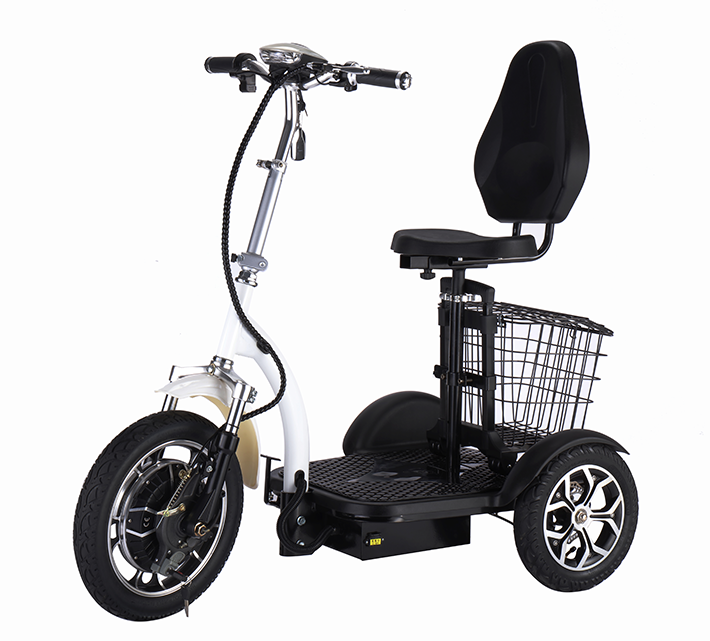
The seat design is more ergonomically suited to the elderly: featuring a “curved backrest + adjustable headrest” to support the lower back and neck; the seat cushion is filled with high-density memory foam (8cm thick), combined with a front and rear dual shock absorption system (Wellsmove models feature 31-tube pure hydraulic shock absorbers), reducing vibration even on bumpy roads and preventing back pain from prolonged sitting. For obese or mobility-impaired users, the seat width can be extended to 55cm, and it supports “side-folding handrails”—seniors can fold the handrails outwards when getting on and off the tricycle without having to step over obstacles.
Detailed Adaptation: Catering to “Special Needs” The diverse needs of elderly people worldwide are fully considered: for example, for visually impaired users, some models include “voice prompts” (battery level, speed, turn reminders, supporting multiple languages such as English, Spanish, and Arabic); for users who need to carry canes or wheelchairs, the sides of the vehicle feature “hidden hooks” and “folding storage baskets” (with a capacity of up to 20L, capable of holding folding canes and shopping bags); in the rainy northwest of Europe, models generally come standard with “removable awnings” (made of PC material, waterproof and translucent, not obstructing vision).
De-aging Exterior: Balancing Aesthetics and Confidence Say goodbye to the traditional “monotonous black/gray,” the 2026 models introduce “low-saturation color schemes” (off-white, light blue, light pink), with simpler and smoother body lines, and some brands also offer “personalized stickers” (such as floral and landscape patterns). Wellsmove’s research in the Australian market shows that 72% of seniors said, “Stylish mobility scooters make me more willing to go out”—the design no longer labels “elderly,” but rather makes mobility scooters “partners that improve quality of life.”
Trend Four: Global Compliance—Breaking Market Barriers and Ensuring Legal Travel Differences in regulations regarding mobility scooters for the elderly in different countries have been a major concern for users worldwide (e.g., the EU requires vehicles to pass CE certification, and the US requires compliance with DOT safety standards). In 2026, “compliance” will become a core competitive advantage for products. Brands will need to make localized adjustments for different markets to ensure that users can “register and drive with confidence”:
Multiple standard certifications will be fully covered. Mainstream brands will no longer launch “universal models,” but will instead customize compliant models for different regions: For example, models exported to the EU will have a maximum speed limit of 25 km/h (meeting EU L1e standards) and must be equipped with a “Vehicle Identification Number (VIN)” and “environmental certification”; models exported to the US must meet the Federal Motor Vehicle Safety Standard (FMVSS) and be equipped with “reflective strips” and “parking brake locks”; Wellsmove models exported to Saudi Arabia also specifically meet local “high-temperature durability” requirements (body materials can withstand temperatures above 60°C, and wiring is protected against aging).
Adapting to Local Registration and Insurance Processes
The brand no longer only provides products but also assists users with compliance procedures: For example, Wellsmove provides its Australian partners with a “Vehicle Compliance Package” (including certification reports and parameter lists) to facilitate registration at local vehicle registration offices; in the North American market, it partners with insurance companies to offer “Exclusive Insurance Plans” with premiums as low as $15 per month, covering risks such as collisions and theft, addressing the issue of “not daring to drive without insurance.”
Localized Speed and Function Adjustments
Core parameters are adjusted for different regional road environments: For example, in densely populated Asian cities (such as Singapore and Tokyo), the maximum speed is set at 20 km/h, more suitable for narrow streets; in suburban North America, the speed can be increased to 35 km/h (the maximum speed of some Wellsmove models) to meet the needs of “cross-community travel”; at the same time, for right-hand drive markets (such as Australia and the UK), the control panel and steering wheel are adjusted to the right side to conform to local driving habits.
Trend Five: Lightweight Intelligence – Technology for the Elderly, Not for Disturbance
In 2026, “intelligentization” will no longer be about “piling up functions,” but rather “using technology to reduce the difficulty of use.” Simultaneously, “lightweighting” is becoming a trend, making it easier for seniors to operate the bikes. The combination of these two aspects creates products that are “simple yet sophisticated”:
Lightweight Materials: Effortless and Durable
Traditional steel frames are gradually being replaced by “aluminum alloy + high-strength plastics,” reducing the bike’s weight by 30% (for example, the aluminum alloy frame used in Wellsmove weighs only 28kg, allowing seniors to push the bike independently), while maintaining the same load-bearing capacity (generally over 150kg). This lightweight design not only makes turning and parking easier but also makes it easier for seniors to push the bike into elevators or garages, making it especially suitable for apartment dwellers.
Practical Intelligence: Rejecting “Complex Operations”
Intelligent functions focus on “safety and convenience,” not “showy technology”: for example, “mobile app location tracking” (children can remotely view the elderly person’s real-time location to prevent them from getting lost; supports iOS and Android systems), “self-diagnosis” (when the vehicle has a problem, the screen displays a simple code, such as “E1 = battery failure,” for easy troubleshooting by maintenance personnel), and “one-click SOS” (in an emergency, pressing the red button next to the seat automatically dials a preset emergency contact number). These functions all support “physical button operation,” eliminating the need for seniors to learn how to use smartphones.
Screenless Interaction: Lowering the Cognitive Barrier
Avoiding complex touchscreens, interaction is achieved through “voice + physical buttons”: for example, if an elderly person says “open the canopy,” the vehicle automatically starts the canopy motor; pressing the “home button” allows the vehicle to assist in returning to the starting point based on a previously recorded route (but manual steering is required to avoid the risks of fully autonomous driving). This design is especially suitable for seniors unfamiliar with electronic devices, truly realizing “technology serving people, not people adapting to technology.”
2026: Senior Citizen Tricycles – More Than Just “Transportation Tools”
From a global perspective, the core trend for senior citizen tricycles in 2026 is “centered on the independent living needs of the elderly”—they are no longer just “tools to assist with travel,” but rather “bridges” that help the elderly maintain social connections and participate in society. Whether it’s Wellsmove’s “large storage space model” designed for Saudi families (convenient for family picnics) or the “outdoor weather-resistant model” customized for Australian users (adaptable to grassland conditions), the essence is answering one question: “How can we ensure that seniors worldwide can enjoy every short trip safely and with dignity?”
Post time: Jan-14-2026